
Revere Wood Flooring has been doing wood floor refinishing in Revere, MA for more than 20 years, serving surrounding cities including Chelsea, Nahant, Winthrop Town, Everett and Malden. Most of what we refinish is red oak laid between 1900 and 1960, with eastern white pine in the oldest houses and prefinished engineered plank in the newer buildings, and each of those wants a different machine, a different grit sequence and a different finish.
Refinishing is the cheapest way to get a floor you would be happy to photograph, and it is also the easiest job to get wrong in a way that cannot be undone. Wood removed by a drum sander does not come back. That is why every quote we write starts with two measurements — how much wood is left above the tongue, and how much moisture is in the boards and the subfloor — rather than with a rate per square foot.
What you get from us is a written scope that names the species, the grit sequence, the number of coats and the exact product, with a fixed price against it. If your floor is a candidate for a screen and recoat instead of a full sand, we will tell you that too, even though it is a much smaller job.
What Refinishing Can And Cannot Fix
Bare Traffic Lanes And Dulled Finish
Hallways, the run in front of a kitchen sink and the path from a back door wear through the finish long before the rest of the room does. Once the wood under them is bare it starts taking in dirt and moisture, and the lane goes gray. Caught early this is textbook refinishing work and often only needs a screen and recoat; left two more winters it is a full sand and sometimes board replacement.
Water Stains, Cupping And Crowning
Cupping — board edges standing proud of the center — means moisture reached the wood from underneath, and a sander cannot fix the cause. We meter the boards and the subfloor, dry the assembly and wait for the readings to settle before any abrasive touches it. Sanding a cupped floor flat while it is still wet produces crowning as it dries, which is a second, worse problem created by the repair.
Black Pet Urine Stains And Deep Gouges
Dark urine staining is a chemical reaction in the wood rather than a film on the surface, and where it reached the subfloor no sanding depth will lift it. Deep gouges that go below the sanding depth behave the same way. Both are board replacement jobs first and refinishing jobs second, and we weave matching stock in so the repair vanishes under a single finish rather than reading as a patch.
Reading The Floor Before The Sander Runs
Remaining Thickness Above The Tongue
A solid strip floor only has so much wood above the tongue, and every sanding spends some of it. We pull a register cover, check a closet edge or lift a threshold to see what is actually left, because a floor already taken down three times will start throwing nail heads and splitting at the board ends if it is cut again. Where the number is low we price a screen and recoat and say why.
Moisture Readings Through Boards And Subfloor
A moisture meter tells us whether the floor is at equilibrium or still drying out from something. Readings are taken in several rooms and into the subfloor, not at one convenient spot, because a slow leak under a dishwasher or a riser in a wall reads normal three feet away. Finishing over wood that is still giving up moisture traps the problem under the coating.
Build Year And Painted Surfaces
With 65.4 percent of Revere’s housing units built before 1980, the build year is part of the estimate rather than a footnote. Massachusetts administers its own renovation rules under 454 CMR 22.00, and power sanding a painted surface without HEPA-filtered exhaust is prohibited outright. We read the year and look at painted treads, aprons, baseboards and thresholds before scheduling, not after the equipment arrives.
Color, Stain And Sheen On Red Oak
Orange Oak Taken Back To Natural
The orange cast people want gone is almost never the wood. It is an old shellac finish or an amber oil-modified polyurethane that has ambered further with age. Sanding to bare and finishing in a waterborne product brings red oak back to something close to its natural tone, and that alone changes how a room reads without any stain at all.
Stain Samples On Your Own Floor
A stain chip in a showroom tells you almost nothing, because color depends on the species, the grain, the grit the floor was sanded to and the light in your room. We lay samples directly on your sanded floor and look at them in daylight and under your own lamps. On species that blotch, such as maple, water popping is the step that decides whether a stain lands evenly.
Sheen Level And How It Wears
Sheen is a wear decision as much as an aesthetic one. Higher gloss reflects more light and shows every scratch, dust particle and pet nail; matte and satin hide traffic and are far more forgiving in a hallway or a rental. We talk through the sheen with the actual room in mind, because the same product at two sheen levels ages very differently in a high-traffic unit.
Finishes, Cure Time And Living With The Job
Waterborne Polyurethane
Waterborne finishes clear fast, carry far less odor and stay clear rather than ambering, which is what most people want on a floor going back to natural. They are the usual choice when somebody is staying in the unit, when a rental has to be re-let quickly, or when a listing photograph is booked. Massachusetts caps varnishes and sanding sealers at 350 grams per liter under 310 CMR 7.25(11), tighter than the federal limit, and everything we apply is picked against that rule.
Oil-Modified Polyurethane And Hardwax Oil
Oil-modified polyurethane is tough, warms the floor’s color and costs less, but it smells strongly and takes much longer to become livable. Hardwax oil penetrates rather than filming over the wood, giving a low-sheen, repairable surface that suits wide plank and old pine particularly well. We match the product to how the room is used and how quickly you need it back, not to what is easiest to apply.
Dustless Sanding And Containment
Our drum sanders, edgers and buffers run to HEPA-vacuum containment rather than a bag, and we mask cabinets, closets and HVAC returns on top of it. That keeps the dust out of the rest of the house and, in a pre-1978 home, keeps the job inside the state’s renovation rules. It is not a sealed environment and we do not describe it as one.
Our Step-by-Step Wood Floor Refinishing Process
Walk-Through And Measurement
We measure every room, identify the species and the fastening, check remaining thickness and take moisture readings. Anything that is repair rather than refinishing — radiator patches, board replacement, squeaks, tack strip from old carpet — is listed separately so you can see what is driving the price.
Repairs And Preparation
Boards get replaced, patches get woven in, squeaks get refastened and any pad, staples, tack strip or adhesive left from a previous floor covering comes out. All of it happens before the first sanding pass, because a patch installed after the floor is finished is visible from the doorway for the life of the floor.
Sanding Through The Grit Sequence
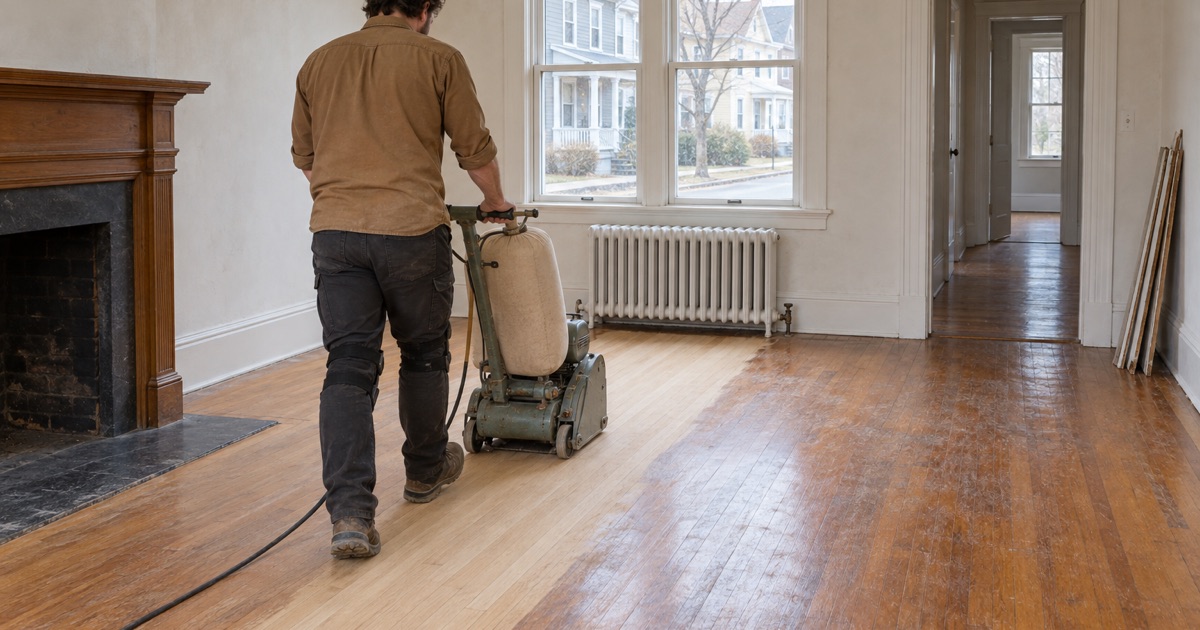
The floor is cut with a drum sander through a planned grit sequence, edged into the perimeter and blended with a buffer or an orbital sander so no machine mark carries into the finish. Skipping a grit leaves scratches the previous grit made, and those only become visible once the stain is on.
Stain, Water Popping And Samples
If the floor is being stained, samples go down on the sanded surface and you pick in your own light. Where the species needs it, we water pop the grain so the color takes evenly rather than blotching. Nothing is committed across a whole room until the sample has been seen dry.
Coats, Cure And Handover
Finish goes on in the number of coats the scope specifies, with an abrasion between coats where the product calls for it. We give you three separate dates at handover: when you can walk on it, when furniture can come back, and when rugs can go down. Those are not the same day, and treating them as one is the most common way a new finish gets damaged.
- 20+ Years on New England Floors
- Free Written Estimates
- Dustless Sanding