
Revere Wood Flooring supplies and installs solid hardwood flooring in Revere, MA and the surrounding cities including Chelsea, Nahant, Winthrop Town, Everett and Malden, with more than 20 years of work behind it. Solid wood is still the floor we recommend wherever conditions allow it, for one reason that no marketing can improve on: it can be sanded and refinished again and again, which makes it the only floor in the house that gets a second life.
That suits the housing here. Revere counts 24,139 housing units and 6,219 of them were built in 1939 or earlier, most on wood-framed subfloors that take a nailed floor happily. Where the substrate is concrete, below grade or heated from underneath we will tell you plainly that solid hardwood is the wrong product — but above grade over a sound wood subfloor, nothing else lasts as long.
Every installation we quote names the species, the cut, the grade, the width, the fastener and the finish, with a fixed price against it. The specification is not a formality; each of those choices changes how the floor looks in ten years.
Choosing The Species And The Cut
Red Oak, White Oak And Maple
Red oak is what most floors in this area were originally laid in — warm in tone, open in grain, and forgiving with stain, which is why it matches existing work so easily. White oak is harder, cooler in undertone and tighter in grain, and it is the species behind most natural and gray finishes. Maple is harder still, very pale, and blotches under stain unless it is handled carefully.
Rift And Quartersawn Versus Plainsawn
Plainsawn boards show the familiar cathedral grain and are what the great majority of floors use. Rift and quartersawn boards are cut so the growth rings meet the face more steeply, producing a straight, quiet grain and noticeably less seasonal movement across the width. They cost more per square foot and are worth it where stability matters or where the look is the point.
Grade, Character And What Shows After Finish
Grade describes how much natural character the boards carry: select and better runs clean and uniform, while common grades include knots, mineral streak and color variation. Neither is better wood — they simply read differently once finished, and they read very differently next to each other. Matching the grade of an existing floor is as important as matching the species when new work meets old.
Board Width, Thickness And Janka Hardness
Strip, Plank And Wide Plank
Narrow strip flooring is the classic pre-war look and moves the least across its width. Plank and wide plank make a room read larger and show more of the grain, and they also show seasonal gapping more clearly because each board carries more wood across. Where a client wants wide boards in a house with big humidity swings, we discuss that tradeoff before ordering rather than after the first winter.
Janka Hardness And How A Floor Takes Wear
Janka hardness is a standard measure of how well a species resists denting, and it is useful for comparing woods rather than predicting a floor’s life. Dogs, chair legs and grit tracked in from the street are what actually mark a floor, and a harder species only slows that down. Finish choice and a decent entry mat do more for a hallway than moving up the hardness scale.
Solid Thickness And Refinishing Lifespan
The wood above the tongue is the floor’s real budget, because every sanding spends some of it. A standard three-quarter-inch solid floor has generous room and can usually take several refinishings across its life; thinner solid stock has less. We tell you what a given product will realistically allow, and on an existing floor we measure what is left before quoting a sanding at all.
Subfloor, Fasteners And Expansion
Subfloor Flatness And Fastening
We check the subfloor for flatness, fastening and moisture before anything is ordered, and correct what is out of tolerance. In houses of this age the subfloor is frequently board rather than plywood, occasionally laid diagonally, and it has often moved. High spots become squeaks and hollow areas; low spots leave boards unsupported and working. This is unglamorous work and it decides everything afterwards.
Flooring Cleats Versus Staples
Cleats flex slightly as the board moves seasonally and hold without crushing the tongue; staples grip harder and can split a tongue on dense or narrow stock. Board width, species and subfloor thickness decide which belongs in the gun. The wrong fastener rarely fails on install day — it shows up as squeaks and movement in the second or third winter, when finding it is far more expensive.
Expansion Gaps And Seasonal Movement
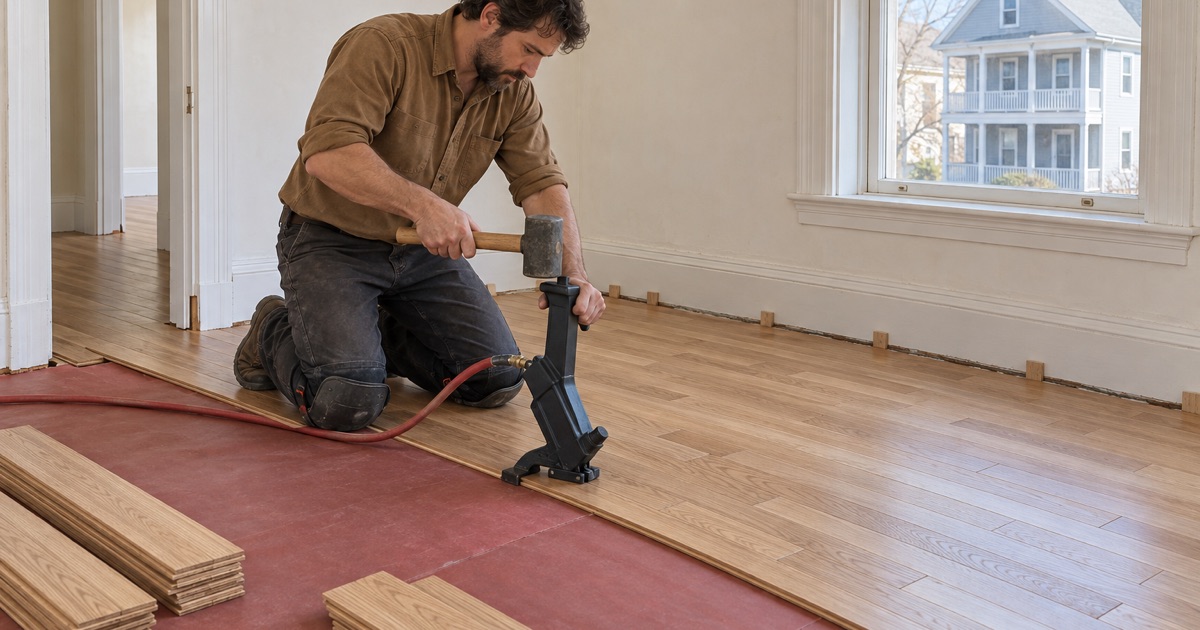
Solid wood has to be free to grow and shrink, which means a maintained gap at every wall and every vertical obstruction, hidden afterwards by baseboard or quarter round. A floor pinched at the perimeter has nowhere to go in a humid August and pushes itself up off the subfloor. Most buckled floors we are called to were installed tight, not flooded.
Prefinished Or Site-Finished
Site-Finished Floors And A Continuous Surface
A site-finished floor is installed raw, then sanded and coated in place. The result is a single continuous surface with no bevel line between boards, which reads as one floor rather than as a collection of planks and cleans far more easily. It also lets us match color and sheen exactly to an adjoining room.
Prefinished Boards And A Fast Turnaround
Prefinished flooring arrives with a factory-cured finish and is walkable the day it goes down, with no sanding dust and no cure time in the unit. That is decisive for a rental turnover working against a vacancy window, or for an occupied home where nobody can move out. The tradeoff is the micro-bevel at every board edge and a color you cannot adjust on site.
Matching A New Floor To An Existing One
When new flooring meets an existing floor — after a wall comes out, an addition, or a room that was always carpeted — the match has to work in species, cut, grade, width and thickness before color is even discussed. Where the two can be sanded and finished together, the result is seamless. Where they cannot, we say so and design a deliberate transition instead of a bad blend.
Our Step-by-Step Solid Hardwood Flooring Process
Measure, Test And Specify
We measure each room, check subfloor type, flatness and moisture, and look at every transition the new floor has to meet. You get a written specification naming species, cut, grade, width, fastener, finish and coat count, with substrate correction listed separately so its cost is visible.
Delivery And Acclimation
Material is delivered ahead of installation and acclimated in the rooms it is going into, with the house conditioned as it will be in service. Moisture readings are taken on delivery and again immediately before installation, and the second reading is what authorizes the start.
Subfloor Preparation And Layout
The subfloor is flattened, refastened and cleaned, then the layout is set from the room rather than from a wall — older houses here are rarely square, and starting off a crooked wall puts the error into the middle of the floor. Expansion gaps are established at the perimeter before the first row is fastened.
Installation, Finishing And Handover
Boards are racked for color and character, fastened by the specified method, and finished on site or left prefinished as the scope says. Trim, thresholds, reducers and nosings complete the perimeter. At handover you get the maintenance schedule for your specific finish and, on a site-finished floor, the separate walk-on, furniture and rug dates.
- 20+ Years on New England Floors
- Free Written Estimates
- Dustless Sanding