
Revere Wood Flooring screens and recoats hardwood floors in Revere, MA, serving surrounding cities including Chelsea, Nahant, Winthrop Town, Everett and Malden. It is the least glamorous service we offer and the one that saves clients the most money, because a floor recoated at the right moment never needs the full sanding that would otherwise be coming.
The whole idea is simple. The finish is a sacrificial layer sitting on top of the wood, and it is the finish that wears, not the oak. Renewing that layer before it wears through costs a fraction of a refinishing, takes a day rather than a week, and spends none of the wood above the tongue — which is the only resource a solid floor cannot replace.
The catch is timing, and it is the reason this page exists. A recoat is only available while the wood is still covered. Once a hallway has gone bare and gray, the cheap option has expired and the choice is between living with it and a full sand.
What A Screen And Recoat Actually Does
Abrading The Existing Finish
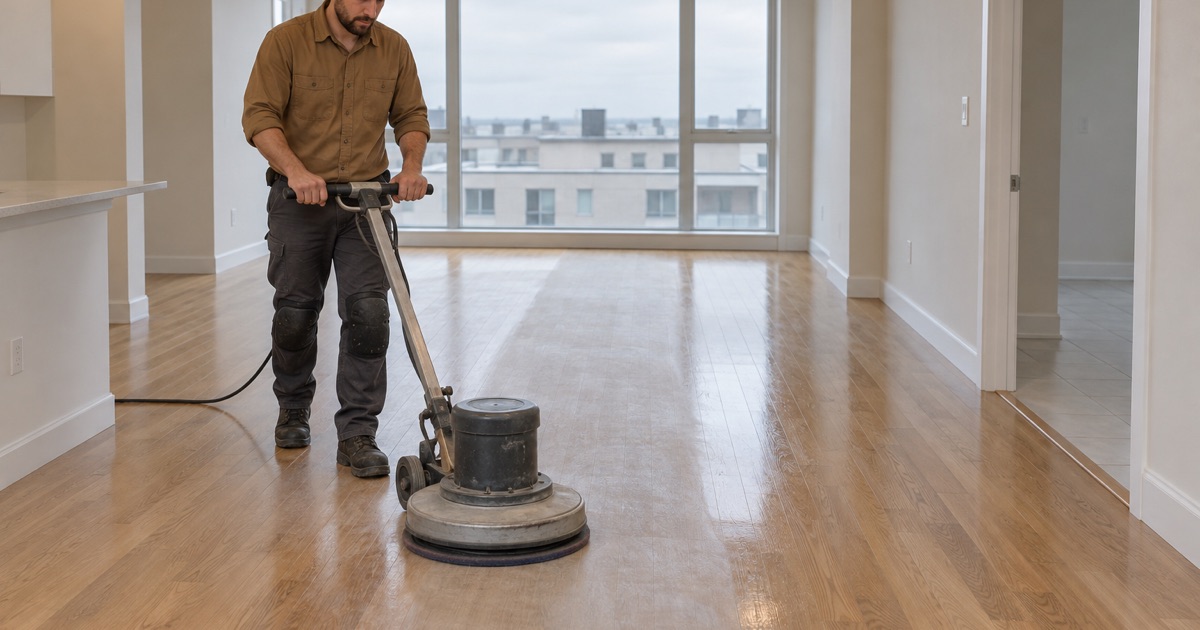
A buffer fitted with an abrasive screen keys the existing finish, taking off the top microns of coating and leaving a uniformly scuffed surface for the new coat to grip. The wood is never reached. Edges, corners and under-radiator areas are abraded by hand, because a buffer cannot get there and an unabraded strip is exactly where a new coat later peels.
One Day On Site, No Wood Removed
A typical unit is cleaned, screened, vacuumed, tacked and coated within a working day. There is no drum sander, no grit sequence and very little dust compared with a full sanding, which is why it suits occupied homes. Most importantly, the floor’s remaining thickness above the tongue is exactly what it was that morning.
How It Differs From A Full Sand
A full sanding cuts to raw wood and can change the color, remove stains, flatten a cupped floor and erase deep scratches, at the cost of wood and a week of the room being unusable. A recoat does none of those things and costs a fraction as much. Choosing between them is not a budget question — it is a question about the condition of the wood.
When Your Floor Is A Candidate
Finish Worn But Wood Not Bare
The ideal candidate is a floor where the coating looks dull and tired, perhaps with a visible traffic pattern, but there is no raw wood anywhere and no gray discoloration. That floor gets back to looking new for the price of a day’s work. We check the worn areas in raking light, where the difference between a thin finish and a bare one is obvious.
Scratches In The Coating Only
Pet nails, grit and furniture put fine scratches into the finish long before they reach wood. Screened and recoated, those disappear completely, because the abrasive takes the coating down past them and the new coat fills the rest. Scratches that cut through into the wood do not disappear, and we will point those out on the walk-through.
Regular Maintenance Before Damage Starts
Treating a recoat as scheduled maintenance rather than as a repair is how a floor lasts through several owners. Every recoat postpones a sanding, and every sanding avoided leaves wood above the tongue for a later one. Clients who recoat their hallway every few years still have original 1920s oak that looks new; clients who wait are choosing between gray boards and a full refinishing.
When It Will Not Work
Bare Wood In The Traffic Lanes
Once the finish has worn through, the exposed wood absorbs dirt and moisture and turns gray, and no coating put over the top will lift that. A recoat there seals the discoloration in permanently. This is the single most common reason we decline a recoat and quote a sanding instead, and we would rather say it at the estimate than after the coat is down.
Stains That Went Into The Wood
Pet urine, water staining and anything else that has reacted with the wood sits below the coating. A recoat covers it rather than removing it, and it will still be there — usually more obvious, because everything around it now looks fresh. Those areas need board replacement or a full sanding depending on how deep the damage runs.
Waxed Floors And Contaminated Finishes
Adhesion is the whole risk in this job. Wax, oil-based cleaning products and silicone residues prevent a new coat from bonding, and some very hard factory finishes resist keying. We test adhesion in an inconspicuous spot before committing, because a recoat that fails to bond peels in sheets and then has to be sanded off completely — the most expensive possible outcome.
Where It Earns Its Keep In Revere
Rental Turnovers Inside The Vacancy Window
Revere requires a vacant dwelling unit to be inspected and issued a Certificate of Fitness before a new tenant occupies it, and the unit has to be completely vacant for that inspection. That gap between tenants is short, and a one-day recoat fits inside it where a week-long sanding does not. For a landlord it is the difference between a fresh-looking floor and a lost month of rent.
Occupied Condos And Elevator Buildings
With 4,875 of Revere’s housing units in buildings of fifty or more, a great deal of this work happens in occupied units above ground level. A recoat means one day of access, far less dust, a low-odor waterborne finish and no drum sander running over somebody else’s ceiling. It is very often the only floor service a trust and a downstairs neighbor will both accept without argument.
Getting A Floor Ready For A Listing
A tired floor photographs badly and costs more in a listing than a recoat would. Booked two weeks before photography, a screen and recoat gives clean, even, reflective floors in every room with no schedule risk. A full sanding rushed into the last three days before an open house is how a seller ends up photographing a floor that has not finished curing.
- 20+ Years on New England Floors
- Free Written Estimates
- Dustless Sanding