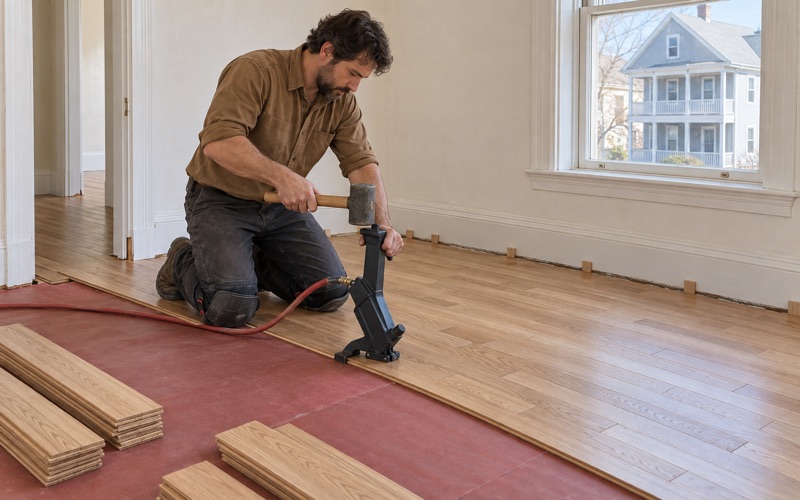
Revere Wood Flooring has spent more than 20 years on wood flooring in Saugus, and the larger share of that work is bringing an existing floor back rather than starting a new one. The first question on most jobs in this town is not what to put down, but how much of what is already down is still worth saving.
We read the floor before we price it. Old pine and early oak get checked for remaining thickness, because a floor that has been sanded three or four times has very little left to give, and the engineered wear layer on a newer board gets measured with a gauge rather than estimated by eye. Solid hardwood, parquet, herringbone and prefinished plank each want a different approach, and that decision belongs at the doorway, not halfway through a grit sequence.
The rest of this page is the part that is specific to Saugus: what the town asks of a property owner and what it does not, what an older housing stock changes about the sanding itself, and how a project gets sequenced around people who are still living in the house while it runs.
What the State Is Paying For at Saugus’s Public Housing
In November 2025 the Massachusetts Executive Office of Housing and Livable Communities awarded $555,492.17 to the Saugus Housing Authority for a roof replacement at Laurel Towers, a state-aided elderly and disabled housing development the Authority runs. The money comes through the Affordable Homes Act. We have no part in that award and no work under it. We raise it because it is dated, public evidence that the town’s older subsidized housing is getting systematic physical attention, and because capital work overhead has consequences for the floor underneath it.
A roof award pays for a roof
The scope named in that award is roof replacement. Flooring is not in it, and no one should read a capital grant for a building envelope as money for finishes inside the units. What it does signal to anyone managing an older property is the sequence that experience keeps confirming: the envelope gets settled first, and interior surfaces come after it, not alongside it.
Floors in a building that is getting other work done
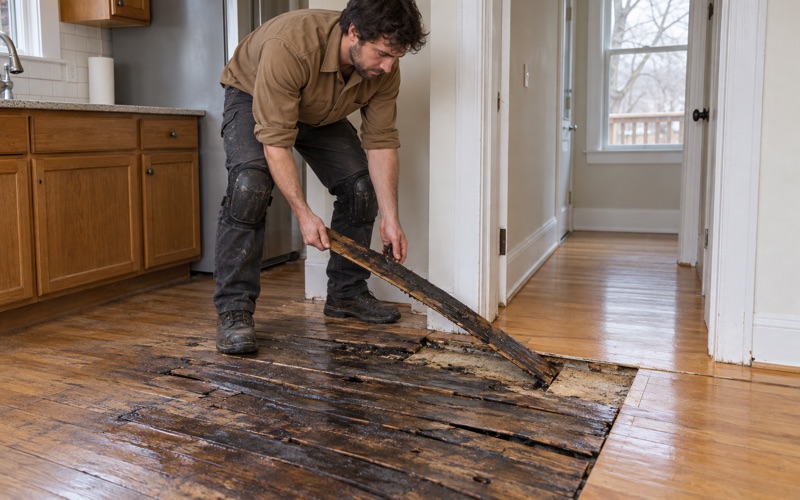
Water that has been arriving from above for years leaves a record in the boards, and the record is readable. Cupping, where the edges of each board sit higher than the middle, means the underside took on more moisture than the face. Crowning is the same story told backward, usually a cupped floor that was sanded flat while it was still wet and then finally dried out. Buckling, where a run of boards lifts clear of the subfloor, is the end of that progression.
Meter first, sand second
We take moisture meter readings before quoting a refinish anywhere water has been coming in, and we take them again on the morning we start. A floor reading high gets time, air movement and another reading instead of a drum sander. Flattening a wet floor turns a seasonal problem into a permanent one, and it is the most common reason an older floor ends up refinished twice inside three years.
Looking for wood-flooring closer to Lynn? See Wood-Flooring in Lynn.
No Turnover Inspection Here, and a Housing Stock That Predates One
We went looking for a Saugus rental-unit registration rule, a turnover-inspection requirement, a condominium-conversion bylaw and a local tenant-protection ordinance, and found none of them. The town has no rent control law and no local just-cause ordinance either. For an owner turning a unit over, that means the calendar belongs to the lease rather than to a town inspection date.
The schedule is the lease, not the town
About 3,122 of Saugus’s 10,958 occupied units are renter-occupied, 28.5 percent, which is a smaller rental share than most of the communities around the hub. When one of those units does come open, the window is whatever the owner has between the old tenant leaving and the new one signing. We work vacant units inside that window and finish them so the unit can be walked, signed off and re-let on schedule, which usually means choosing a finish by how fast it takes traffic rather than by what the showroom sample looks like.
Build year is the date that actually binds
71.9 percent of the town’s 11,402 housing units were built before 1980, and 29.4 percent predate 1940 outright. Massachusetts runs its own lead-safe renovation rules on housing built before 1978, so build year and painted surfaces get read before the sander is switched on. Sanding is dust, and baseboard, molding, door casing and stair risers are all painted surfaces sitting at the edge of the work.
An absent local rule is not an absent standard
The absence of a Saugus-specific checklist does not mean a rental floor is held to nothing. It means the standard is a state one rather than a town one, and that the condition of a floor is judged at the unit rather than at a scheduled municipal visit. Practically, it shifts the burden onto documentation: we photograph and measure what we found and what we did, which is the record an owner wants when a question comes back later.
Sanding an Older Saugus Floor
Building has been going on in this town a long while — the iron works at Hammersmith, the first integrated iron works in North America, dates to 1646 — and 3,349 housing units here were finished in 1939 or earlier. Another 1,373 went up in the 1950s and 1,652 in the 1960s. Those three groups do not sand the same way.
Old pine and early oak
The oldest floors in Saugus are often wide eastern white pine or old-growth pine, face nailed with cut nails, and they are soft enough that an aggressive first pass takes more than it needs to. We start those on a gentler grit and a lighter machine, and we check thickness at a vent or a threshold before committing. An orange oak floor under an aged shellac finish reads darker than the wood actually is; a sample panel settles that argument before the whole room is opened up.
Oak that is under something else
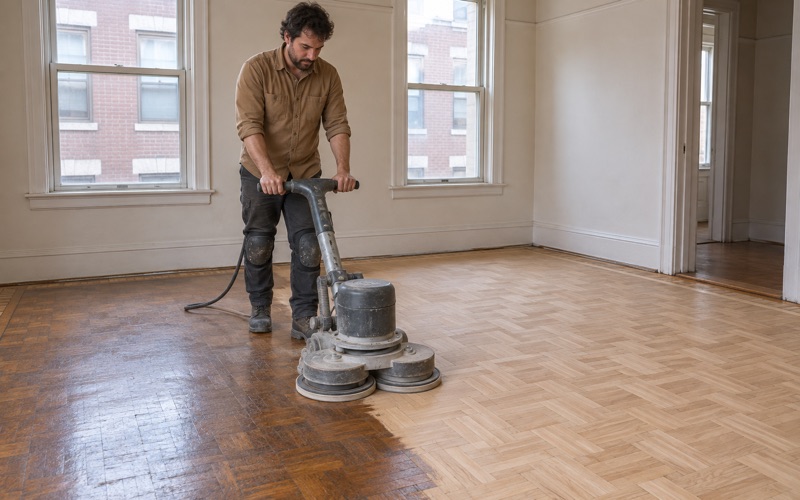
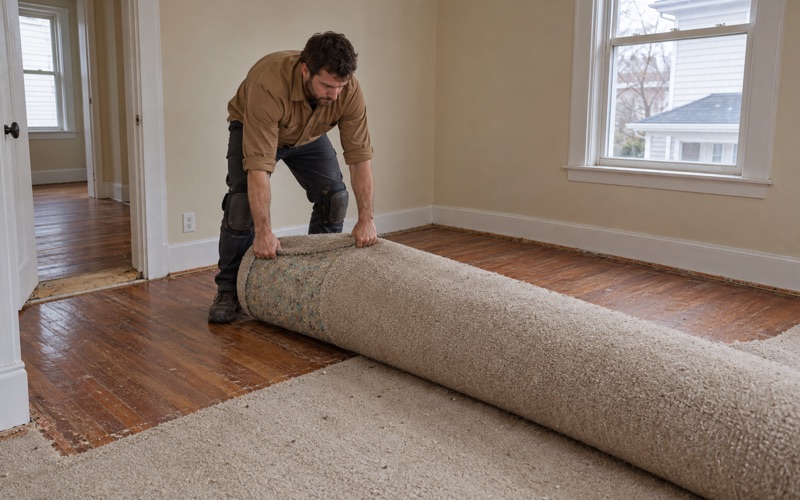
A good share of the red oak and white oak in this town has spent decades under carpet, linoleum or paint. Pad, staples, tack strip and old black mastic all come off before any sanding happens, because an adhesive residue dragged through a drum sander loads the paper and burnishes the wood in the same pass. Parquet and herringbone get handled off the diagonal so the buffer is not fighting the grain in four directions at once.
Repairs come before finish, not after
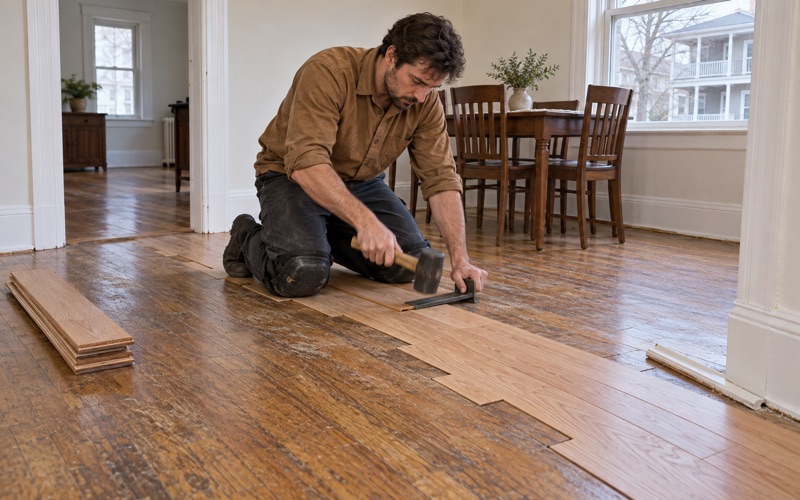
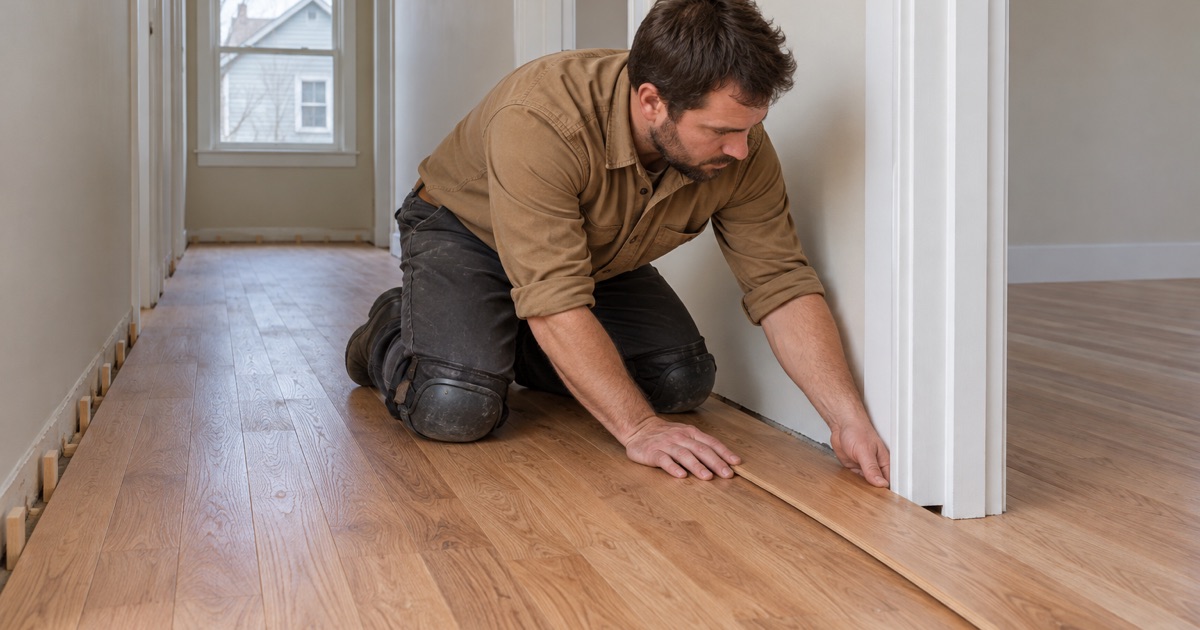
Where an old steam radiator and its riser came out, we weave in matching boards rather than dropping filler into the hole, because filler telegraphs through a finish within a season. The same goes for board replacement around hollow spots, traffic lanes worn through to bare wood, pet urine stains that have gone into the grain, and boards lost to powderpost beetle or carpenter ants. Winter gaps that open and close with the heating season get measured across two visits before anyone decides they need filling at all.
The machines, and the lighter option
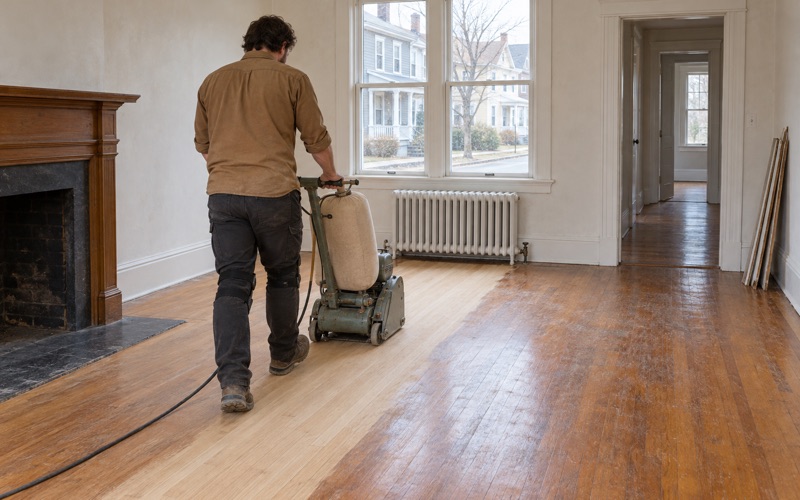
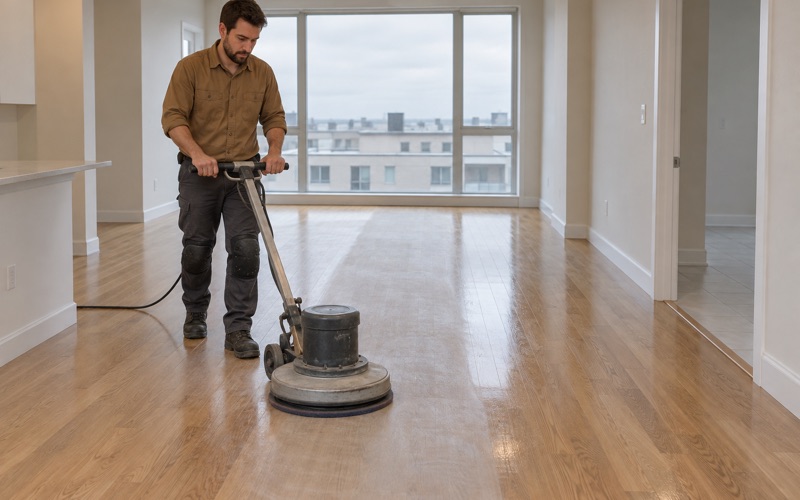
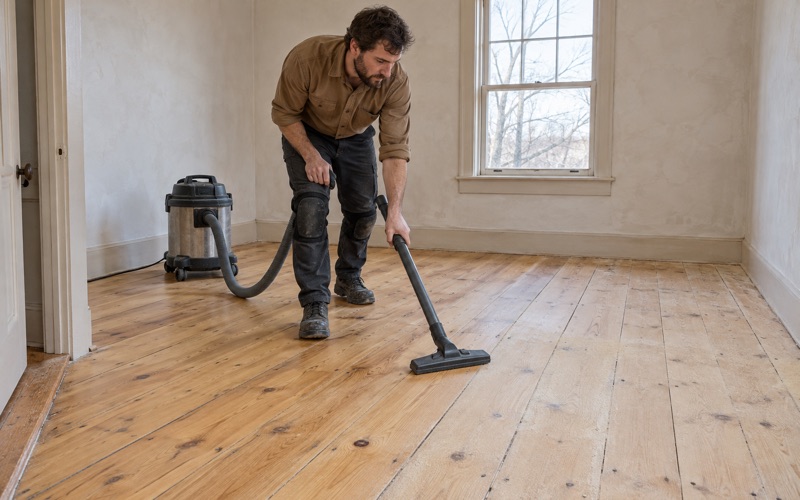
A full refinish is a drum sander, then an orbital sander and a buffer through a planned grit sequence, run with dustless sanding and a HEPA vacuum so the dust leaves with us. Not every floor needs that. A floor whose finish is worn but whose wood is intact takes a screen and recoat instead, which is a fraction of the disruption and leaves the thickness in the boards for a real refinish later on.
Planning a Floor Project in Saugus
Living in the house while it runs
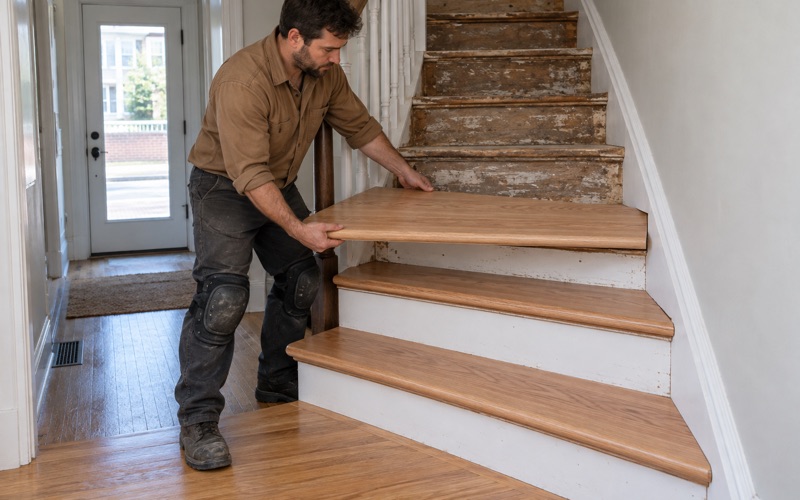
Of the 7,836 owner-occupied households in Saugus, 3,054 are headed by someone 65 or older, and a lot of those owners have no interest in moving out for a week. We stage work room by room where the layout allows it, and in the town’s two-family houses we do one floor at a time so whoever lives on the other floor stays in the house while the work runs. Stairs are quoted by the tread and the riser, with nosing counted separately, never folded into a square-foot number that hides what stairs actually cost.
Finishes chosen against the Massachusetts limits
Massachusetts sets its own coating limits under 310 CMR 7.25, and they are tighter than the federal ones, so a product that is legal elsewhere is not automatically usable here. We work within that list: waterborne polyurethane where fast return to service and low odor matter, oil-modified polyurethane where an amber tone is wanted, hardwax oil where the owner expects to spot-repair later. Sheen level and water popping get decided from stain samples raised on the customer’s own boards, because red oak, white oak and maple all take the same stain differently.
Buildings that carry their own rules
Saugus is mostly detached houses, but the town has hundreds of units in structures of twenty or more, and those buildings usually have rules of their own. Condominium bylaws often set a rug coverage figure and an underlayment requirement, and both get read before a quote goes out rather than after a complaint. We book elevator buildings around the freight schedule and the loading dock, and we plan noisy work with the neighbors below in mind, not just the unit we are standing in.
When the problem started with water
Storm water, surge and burst pipes all end the same way on a floor, and the repair only holds if the source is closed first. We trace where the water came in, dry the assembly and meter it back down to a stable reading before a single board is pulled. While the room is still wet, we photograph and measure it for the adjuster, because the documentation an insurer wants is the documentation that stops existing the moment the floor dries out.
- 20+ Years on New England Floors
- Free Written Estimates
- Dustless Sanding