Revere Wood Flooring handles pine floor refinishing in Revere, MA, serving surrounding cities including Chelsea, Nahant, Winthrop Town, Everett and Malden. Old pine is the floor we are most protective of, because it is the one most often wrecked by a crew running the same drum sander and the same grit sequence they would use on oak.
There is a great deal of it here. Revere counts 6,219 housing units built in 1939 or earlier, and in the oldest of those the original floor is frequently wide eastern white pine, face nailed with cut nails, laid over joists with no subfloor at all. Boards of that width, cut from old-growth timber, are not something you can order.
So a pine job begins with a measurement and a conversation, not with a machine. How much wood is left, how many times has this floor been sanded already, and how much of its character do you actually want removed.
Why Pine Is Not Just A Softer Oak
Eastern White Pine And Old-Growth Stock
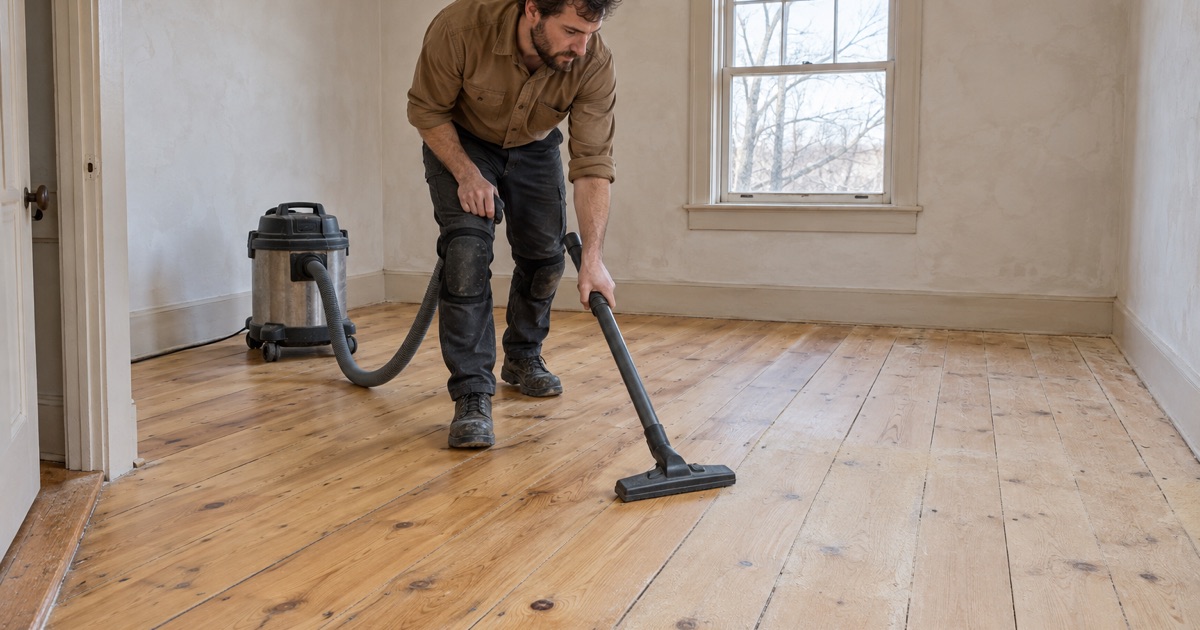
The pine in these houses is not the pine sold today. Old-growth eastern white pine grew slowly, which put the growth rings close together and gave the boards a density and a figure that modern fast-grown stock does not have. It is also frequently in widths no sawmill offers now. That combination is why we repair these floors rather than replace them wherever it is possible.
Softness, Denting And Living With It
Pine takes marks. A dropped pot, a chair leg, a heel and a dog all leave impressions that oak would resist, and nothing in the finish changes that. The honest framing is that a pine floor records the life of the house, and most people who choose to keep one want exactly that. Anyone expecting a dent-free surface should be looking at a different species.
Wide Boards And Seasonal Movement
A wide pine board moves more across its width than a narrow oak strip, so gaps open through a heating season and close again in summer. That is normal behavior, not a defect, and it is the main reason gap filling on these floors goes wrong so often. We measure in-service moisture and treat only the gaps that are genuinely permanent.
Reading An Old Pine Floor Before Sanding
Remaining Thickness And Past Sandings
This is the measurement that decides the job. We check what is left above the fasteners at a threshold, a hearth edge or an existing gap, and compare it against what the floor started as. A floor already taken down several times may have nothing left to give, and in that case the answer is a light abrasion and recoat, or leaving it entirely.
Cut Nails, Face Nailing And Fasteners
Face-nailed floors carry their fasteners at the surface rather than hidden in the tongue, and in older houses those are square cut nails. Every one sitting proud has to be set below the surface before sanding, and there can be hundreds. Missing them destroys abrasives and gouges the boards, and it is one of the slow, unglamorous parts of the job that separates a careful crew from a fast one.
Gaps, Splits And Missing Boards
Old pine splits along the grain, particularly at board ends and around fasteners, and individual boards go missing during plumbing and heating work. We assess which splits are stable and which are structural, and source replacement material of the right width and era where a board genuinely has to go. Reclaimed stock matches these floors far better than anything new.
Sanding And Finishing Pine Properly
Lighter Equipment And A Gentler Grit Sequence
Pine cuts fast, which means a machine set up for oak removes far more than intended in a single pass and can dish the soft early wood between the growth rings. We work with lighter equipment, a gentler grit sequence and more passes at finer grits, blending with a buffer. It takes longer per square foot, and it is the only way the floor comes out flat.
Blotching, Stain And Why Pine Resists It
Pine’s soft and hard bands absorb stain at completely different rates, which is why an unprepared pine floor takes color in patches. Water popping the grain, and a conditioner where the product calls for it, evens the absorption out. We always sample on the floor itself and in the room’s own light, because pine and oak stained with the same product look nothing alike.
Hardwax Oil And Waterborne Finishes On Pine
Hardwax oil penetrates the wood rather than forming a film over it, which suits a soft, moving, wide-board floor: it keeps a low sheen, shows dents as part of the surface rather than as breaks in a coating, and can be spot-repaired without redoing a whole room. Waterborne polyurethane is the choice where a harder film is wanted, and it stays clear rather than ambering.
Keeping The Character Rather Than Erasing It
Patina, Paint Traces And Saw Marks
An aggressive sanding takes off exactly what makes an old pine floor worth having: the color that decades of light and wear have put into the surface, traces of an old painted border, and sometimes original mill marks. We talk through how far down you actually want to go before starting, because that decision cannot be revisited once the machine has run.
Repairing Rather Than Replacing Boards
A split, burned or badly damaged board is replaced individually with reclaimed stock matched for width, thickness and era, woven into the existing run rather than dropped in as a block. Sourcing takes longer than ordering new material, and it is the difference between a repair that disappears into a two-hundred-year-old floor and one that announces itself.
When A Pine Floor Should Be Left Alone
Sometimes the right recommendation is to do very little: clean it, deal with the fasteners, spot-repair the worst boards and put a penetrating finish over the existing surface. A floor that is thin, heavily patinated and structurally fine is often worth more untouched than sanded flat. We will make that case where it applies, even though it is by far the smallest job on this page.
- 20+ Years on New England Floors
- Free Written Estimates
- Dustless Sanding