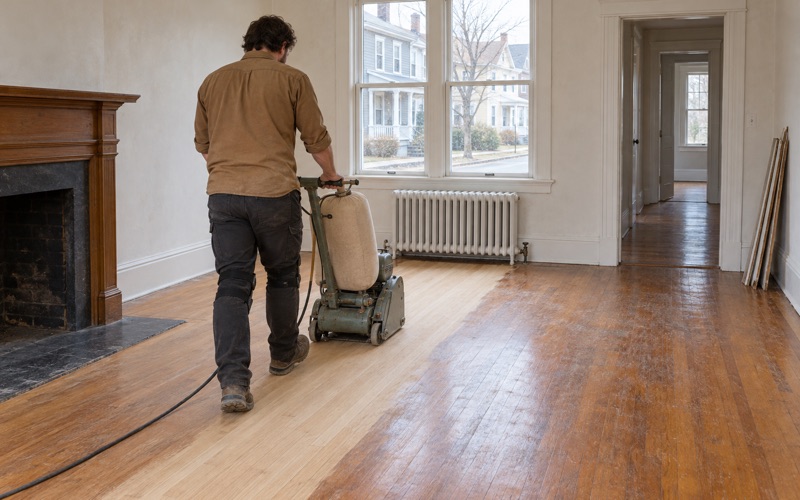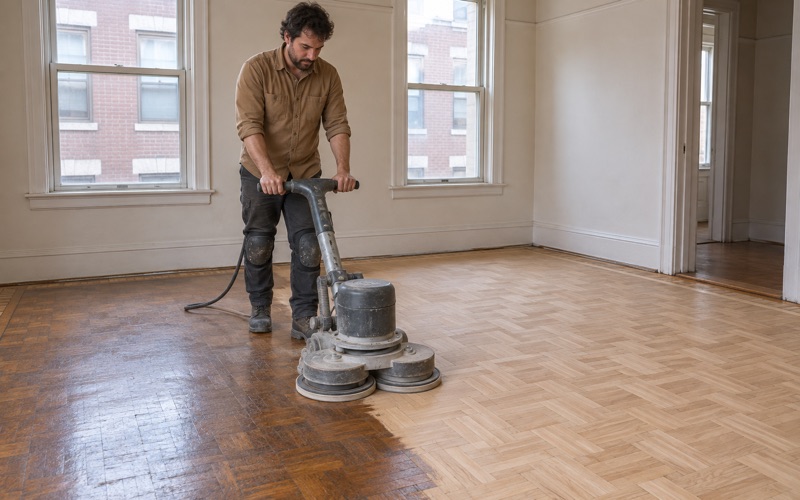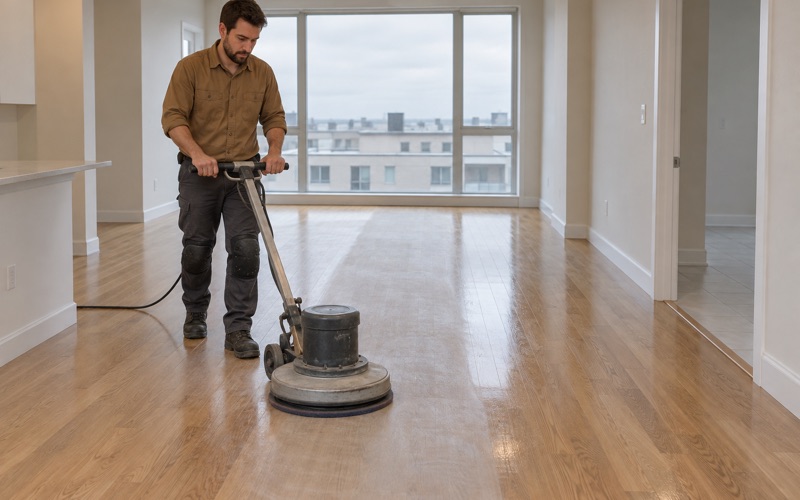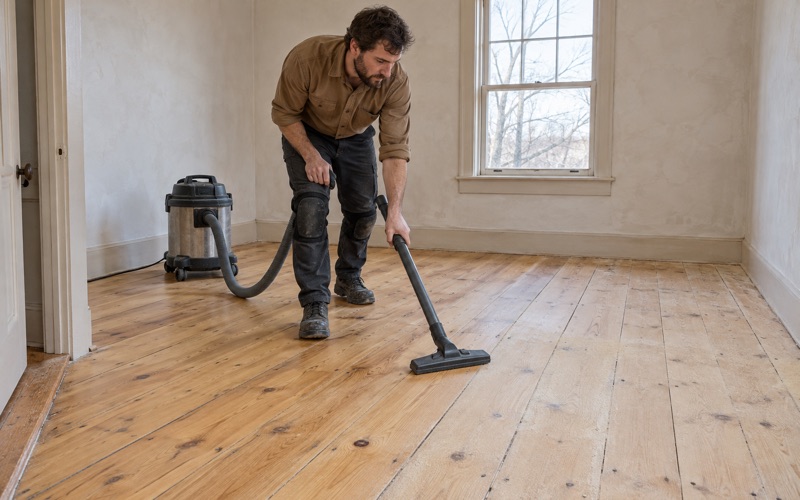
Revere Wood Flooring has been doing wood-flooring in Peabody for more than twenty years, and most of that work is refinishing and repair rather than new installation. We sand, patch and finish floors that are already in the house, in rooms people are still living in and in units that have to be back in service on a date.
The work here splits along one line, and it is not the line most owners expect. A small number of Peabody houses are genuinely old, with floors that have been sanded several times already and cannot give up much more wood. The rest sit in postwar neighborhoods where the boards still have plenty of thickness and the real question is finish and wear.
We quote both the same way. Someone reads the floor first, measures what is left of it, then decides whether it gets a full sand, a screen and recoat, or board replacement in the rooms that have gone past saving. Nothing lands on the schedule before a moisture meter has been on the subfloor.
Old Floors on Washington Street
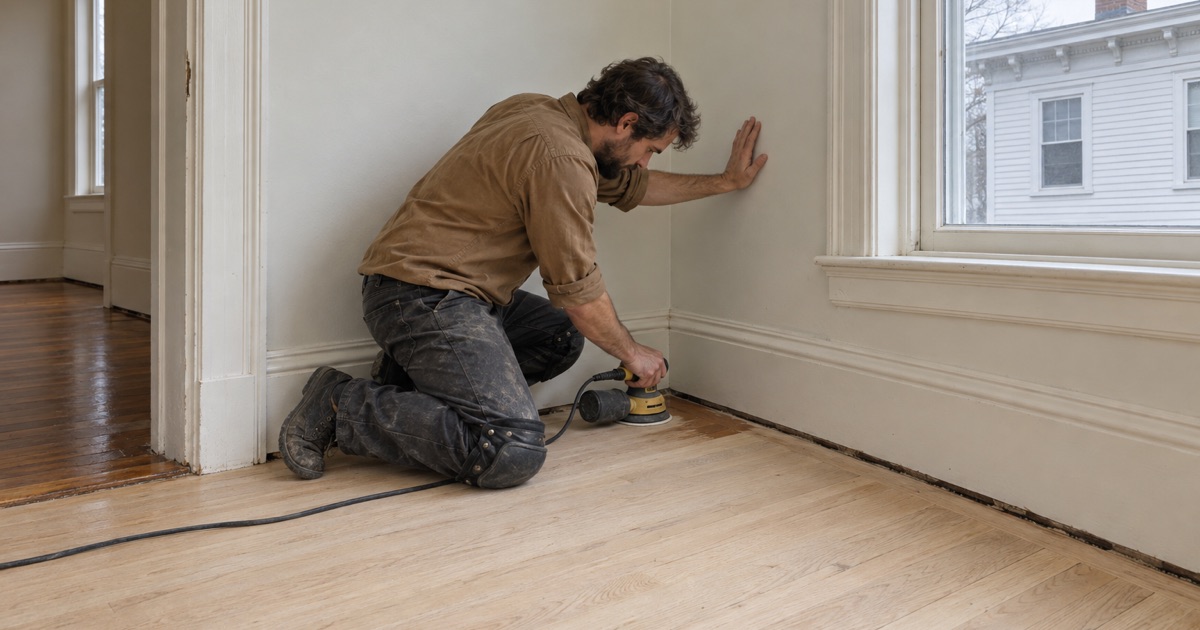
Peabody’s genuinely old fabric is mapped, and it is smaller than the city’s reputation suggests. The Washington Street Historic District was listed on the National Register on September 12, 1985, and takes in 12.8 acres of houses on Washington, Holten and Sewall Streets. The largest number of them carry Greek Revival or Italianate styling, with Federal work among the earliest, and the oldest surviving house on Washington Street is the 1810 Gen. Gideon Foster House, now a local museum.
A house in that range has almost always been refinished before, often more than once, and that history decides what we are able to do. A floor sanded four times has very little wood left above the tongue, and there is no finish that makes up the difference.
Reading what is left before the sander starts
We take a thickness reading at the doorways and along the traffic lanes, where wear runs deepest, and again at a threshold or a floor register where the edge of a board is visible. Cut nails and face nailing tell us something as well, because fastener heads sitting close to the surface limit how aggressive a first pass can be. If what remains is short, we screen and recoat instead, or we sand once on a conservative grit sequence and say plainly that it is the last one that floor will take.
Repairs woven in, not filled
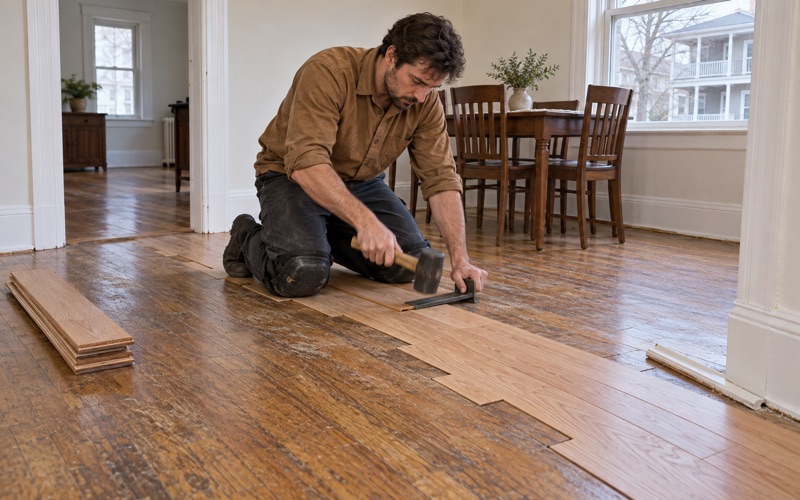
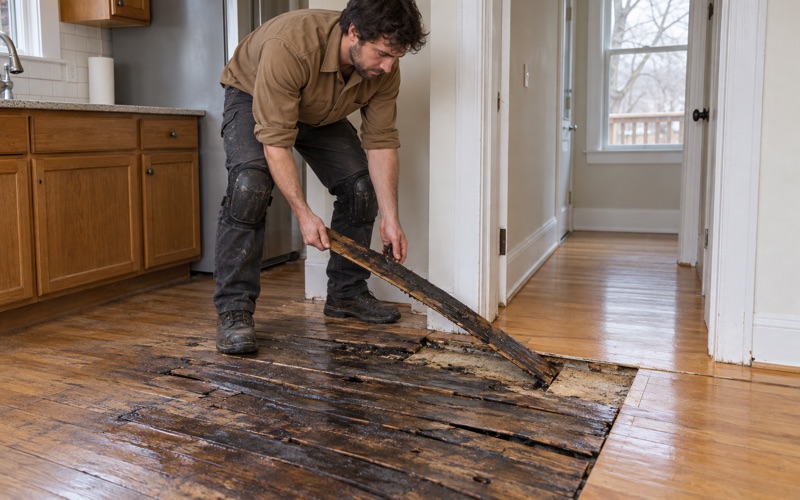
Split, soft or missing boards get replaced with matching stock rather than troweled full of filler. Removed steam radiators and capped risers leave a distinct rectangular hole, and we run new boards into the surrounding field on staggered end joints so the patch does not read as a panel dropped into the room. Where powderpost beetle or carpenter ant damage has hollowed a board out, that board comes up entirely instead of being stabilized in place.
One house, one tannery owner
The district carries Peabody’s leather history in individual buildings rather than in a neighborhood. The Abel Proctor House, built about 1830, is recorded as a Federal period house built for a tannery owner, and the district also holds the 1836 United Methodist Church, moved there from Peabody Square in 1843. Those are single addresses with their own histories, and that is how we approach a quote inside one of them.
Looking for wood-flooring closer to Winchester? See Winchester Wood-Flooring.
What the One-Year Demolition Delay Actually Reaches
The Peabody Historical Commission reviews applications for demolition under the city’s zoning by-laws, and in September 2015 the City Council extended the delay period for buildings the city lists as historic from 90 days to a full year. The vote followed a threatened house at Main and Washington Streets, the O’Shea mansion, estimated at around 250 years old. A year is a long hold on a building, and owners in the older parts of the city are well aware of it.
Two districts, one commission
The Commission oversees two National Register districts. One is the Washington Street district described above; the other is the Civic Center district around the 1883 City Hall and the Central Fire Station. Between them they account for a small share of the city’s buildings, which is why the citywide delay ordinance reaches more owners than either listing does.
Where that review stops
None of it reaches the inside of a house. The delay ordinance governs whether a building comes down, and the district listings govern how the city keeps track of what it has. Sanding a floor, replacing boards or changing a stain color sits outside both, and the decision belongs to the owner of the house.
We raise it because the confusion costs people a season. Owners on those three streets sometimes live with a worn floor for months expecting that someone at the city has to bless the work first. We hold the work to the standard the house deserves either way, keeping original material wherever the remaining thickness allows it, because the building has earned that and not because anyone is checking.
Refinishing Floors in Peabody’s Postwar Houses
Peabody reads as an old North Shore city, and its housing numbers tell a different story. Of 23,081 housing units, 5,031 of them, 21.8 percent, date from 1939 or earlier. Another 3,092 went up in the 1950s and 4,101 in the 1960s, so the typical floor we sand in this city is postwar, in one of the 11,700 units that are one-unit detached houses.
That is mostly good news for the floor. Boards from that era have usually been sanded once or not at all, which leaves thickness to work with and turns the job into a question of appearance rather than salvage. What complicates it is whatever has been laid on top of the floor in the decades since.
Carpet, pad and everything that came with it
Where wall-to-wall has been down for thirty or forty years, the floor beneath is often in better condition than the owner expects, but everything above it has to come off first. Pad, staples, tack strip and any adhesive or black mastic are removed before a sander enters the room, and loose boards and hollow spots get refastened to the subfloor in the same pass. Leaving that for later is how a staple head scores an otherwise sound floor on the first cut.
What is underneath also sets the ceiling on the result. Strip flooring that spent forty years under a pad tends to come up even in color, while a room that lost its carpet early carries darkened traffic lanes and pet urine stains that sanding will lift only so far. We look at a bare corner before quoting a color, because a floor with deep staining is often better stained dark by choice than fought to a natural tone.
Houses built before 1978
Massachusetts runs its own lead-safe renovation rules on homes built before 1978, which takes in practically every house in these neighborhoods. We read the build year and look carefully at painted surfaces, baseboard, quarter round, stair risers and door casings, before the sander is switched on. Dustless sanding through HEPA vacuums keeps what does come up contained instead of chased around the house afterward.
Two-family houses and rental turnovers
About a third of Peabody households rent, and 2,055 of the city’s units sit in two-unit buildings. We take a two-family one floor at a time, so whoever lives on the other floor stays in the house while the work runs, and we sequence around a shared entry and stair so it is never fully out of use. A vacant rental gets a different plan entirely: sand, finish and cure inside the window the owner has before the unit is turned over and re-let.
Planning the Work and Living With the Result
A floor quote that only carries a square-foot rate hides the parts of the job that actually vary. We price the sanding, the repairs, the stairs and the finish separately, and we tell you which of them we are unsure about until the carpet is up or the first cut is made. That way a surprise under the pad changes one line rather than the whole number.
Choosing a finish
Massachusetts sets its own coating limits, tighter than the federal ones, so what we carry is chosen against the state rule before anything else is decided. Inside that we can go waterborne polyurethane for a faster return to service and a clear film, oil-modified polyurethane for a warmer tone that keeps ambering with age, or hardwax oil where an owner wants a low sheen level they can spot-repair themselves.
Stain, sheen and samples
Stain samples go on your own floor rather than on a board carried in from the van, because red oak, white oak and maple each take color differently and an older orange oak floor shifts a stain further still. Where a color has to sit evenly across an open room, we water pop the surface first so the grain takes pigment uniformly. Sheen is settled last, and it is a practical choice: satin buries traffic and dust, higher gloss reports every bit of it.
Stairs, edges and engineered floors
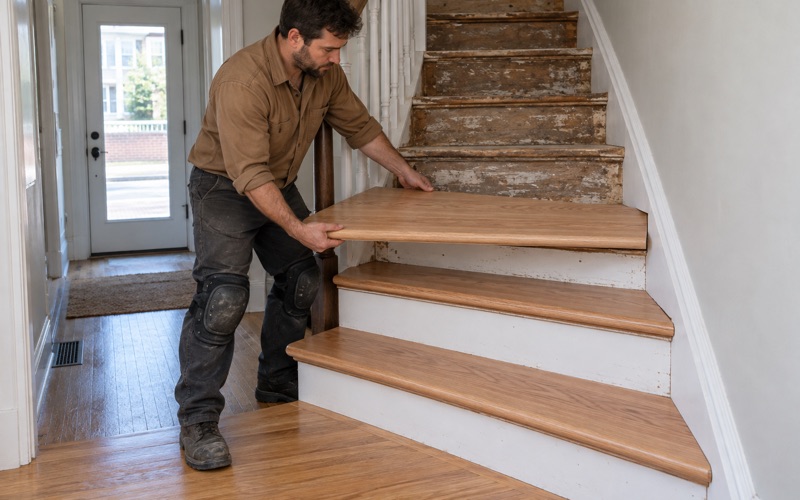
Stairs are quoted by the tread and the riser, never folded into a square-foot number, because a staircase is hand work by the day and a floor is not. Stair nosing, thresholds, reducers and quarter round are priced as their own lines so nothing surfaces at the end of the job. On an engineered floor we measure the wear layer before anyone promises a sand, since some carry enough for a full refinish and some only a screen and recoat, and the difference cannot be seen from above.
Moisture through the year
Heating season pulls moisture out of a floor and opens winter gaps, and a humid stretch closes them again and can leave cupping across a room. We meter board and subfloor moisture before refinishing or installation, hold new material for acclimation, and keep the expansion gap at the walls where the baseboard and quarter round cover it. When water has already come in, from a burst pipe, a failed sump pump or storm water through a door, we trace it to the entry point, dry and meter the structure, and photograph and measure the room for the adjuster while the floor is still wet, before a single board is pulled.
Cure time and the calendar
Cure time is the part of the schedule owners underestimate. A waterborne finish accepts foot traffic sooner than an oil-modified one, but both want days before rugs go back down, and a rug laid on a floor that has not finished curing leaves a mark shaped exactly like the rug. We put those dates in writing with the quote so furniture, pets and tenants can be planned around them rather than negotiated on the last day.
- 20+ Years on New England Floors
- Free Written Estimates
- Dustless Sanding