
Revere Wood Flooring handles parquet floor refinishing in Revere, MA, serving surrounding cities including Chelsea, Nahant, Winthrop Town, Everett and Malden. Parquet turns up constantly in this area’s apartment buildings and mid-century condominium stock, and it is the floor most often ruined by a crew that treats it as though it were strip flooring.
The difference is physical, not stylistic. A parquet tile is thin, it is bonded rather than fastened, and the grain inside a single tile runs in two directions at right angles. Everything that makes a drum sander efficient on an oak strip floor makes it destructive on parquet, and the damage is not recoverable once the short grain has been torn out.
So we start by establishing two things: how much wood is actually left above the substrate, and how much of the floor is still bonded to it. Those answers decide whether the job is a refinishing, a repair and refinishing, or an honest recommendation to replace.
What Parquet Is And Why It Sands Differently
Short Grain Running In Two Directions
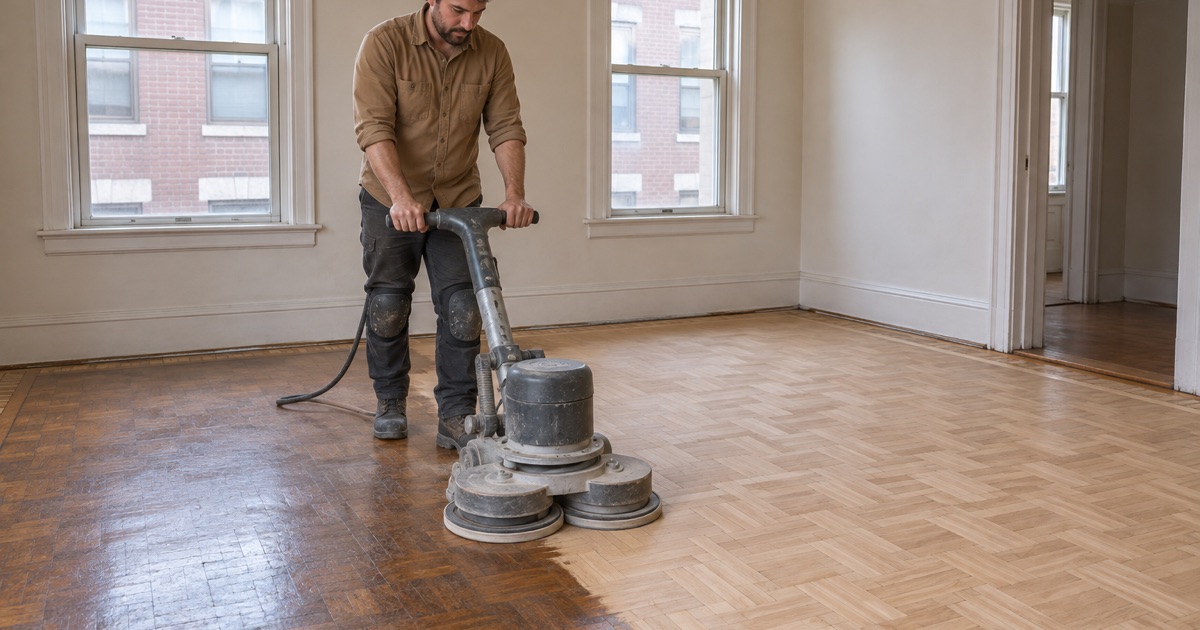
A parquet tile is made of small wood fingers assembled into a square, with alternating blocks turned ninety degrees to each other. That means any single sanding pass runs with the grain on half the tile and across it on the other half. Handled roughly, the cross-grain half splinters and tears, and no amount of finish disguises it afterwards.
Tile Thickness And How Little Is There
Parquet tiles carry a fraction of the wood a three-quarter-inch strip floor does, and many have already been sanded at least once in their lives. We check the remaining thickness at a threshold, a heating vent or a lifted tile before quoting. Where the number is marginal we price a light abrasion and recoat rather than a sanding the floor cannot survive.
Solid Parquet Versus Engineered Tiles
Solid parquet is wood all the way through and can usually take at least a light pass. Engineered parquet tiles have a thin wood face over a backing, and many of those cannot be sanded at all without going straight through the veneer. Identifying which you have is the first thing we do, because the two look identical from above.
Black Mastic And What Sits Under The Tiles
The Adhesive Under Older Parquet
Older parquet was commonly laid in a black bituminous adhesive that stays soft, loads abrasives immediately and smears when it warms. We scrape it back by hand where tiles come up, rather than running a machine through it, and that is one reason parquet work takes longer than the square footage suggests. Nothing about it is a reason to avoid the floor; it is simply a reason not to rush it.
Hollow Tiles And Failed Bond
Walking a parquet floor and listening is genuinely diagnostic. A dull, hollow note under a group of tiles means the adhesive has let go there, often around a radiator, a window or a former leak. We map those areas, lift only what has released, clean the substrate back and re-bond with new adhesive before any refinishing.
Subfloor Condition Beneath A Lifted Tile
Lifting a failed tile is also the cheapest look at the substrate anyone will get. Where the subfloor below has been wet, has lost fasteners or has moved, that is dealt with before tiles go back down. Re-bonding new tiles onto a substrate that caused the original failure simply schedules the same repair for a later date.
Refinishing A Parquet Floor Properly
Sanding Across The Grain Directions
Parquet is worked with lighter machines and a grit sequence planned around the pattern, cutting diagonally to the tile layout so neither grain direction is taken head-on, then blending with a buffer. Edges and corners are handled by hand. It is slower than a strip floor of the same area, and the extra time is what keeps the tile faces intact.
Replacing Missing And Damaged Tiles
Individual tiles can be lifted and replaced within the field where the format is a common one. We match species and block size and set the replacement flush with the surrounding floor so the sanding pass does not have to cut a high spot down. Unusual historic formats are harder, and we say what the match will look like before we start rather than afterwards.
Finish Choice On A Patterned Floor
A patterned floor rewards a finish that stays clear rather than ambering, because the pattern is the point and a yellowed coating flattens it. Waterborne polyurethane suits parquet particularly well for that reason, and Massachusetts coating limits under 310 CMR 7.25(11) are checked on every product we apply. Sheen also matters more here, since higher gloss exaggerates any unevenness across the tiles.
When Parquet Should Be Replaced Instead
Measuring What Is Left To Sand
The decision comes down to a measurement rather than an opinion. Where there is wood above the substrate and the bond is sound, refinishing is dramatically cheaper than replacement and keeps an original floor in place. Where the tiles are thin and worn through in the lanes, sanding will only expose the layers below, and we will not take that job.
Widespread Delamination
Isolated hollow areas are a repair. A floor that sounds hollow across whole rooms has an adhesive or a moisture problem that re-bonding tile by tile will not solve. At that point the honest answer is to lift the floor, address the substrate and start again, and we will quote it that way rather than selling a refinishing that fails within a year.
What Goes Down Instead
Where replacement is the right call, the options are new parquet in a matching or updated pattern, a strip or plank floor, or engineered material where the substrate demands it. We lay out the costs side by side, including what the substrate preparation adds in each case, so the comparison is a real one rather than a sales pitch for the most expensive option.
- 20+ Years on New England Floors
- Free Written Estimates
- Dustless Sanding