Revere Wood Flooring has been sanding, refinishing and rebuilding wood flooring in Newburyport for more than twenty years, and the jobs here rarely begin with a clean rectangle of oak. They begin with a building that has already carried several floors, several tenants and several ideas about what belonged underfoot.
Our work in the city runs from a full sand-and-finish on a floor nobody has touched in decades, to weave-in repairs around a hole somebody else left behind, to a new solid or engineered floor over a subfloor that needs attention first. We quote what we can see, and we say plainly what cannot be known until the carpet, the tack strip and the staples are out of the room.
Much of what follows is about the oldest part of downtown, because the buildings there behave differently from a postwar house and the floors inside them need a different sequence. If your floor sits elsewhere in the city, the same sequence still applies; only the pace changes.
Wood Floors Inside Market Square’s Federal Brick Buildings
The Market Square Historic District is its own National Register listing, entered on February 25, 1971 under reference number 71000088. It covers Market Square along with properties fronting State, Merrimac, Liberty and Water Streets, and the Custom House, now a museum, together with the 1823 Market House form its eastern boundary. The description of the area is blunt about what it holds: a remarkable concentration of Federal style brick buildings.
That matters to a floor crew because the floor is a wooden system sitting inside a masonry one. The brick shell barely moves; the joists, subfloor and finish floor inside it respond to every change in humidity, and the two do not agree at the perimeter. Cupping across the boards, winter gaps that open in January and close by July, and hollow spots where the finish floor has lost contact with what is under it are all ordinary in buildings put together this way.
What Comes Off Before Anything Gets Sanded
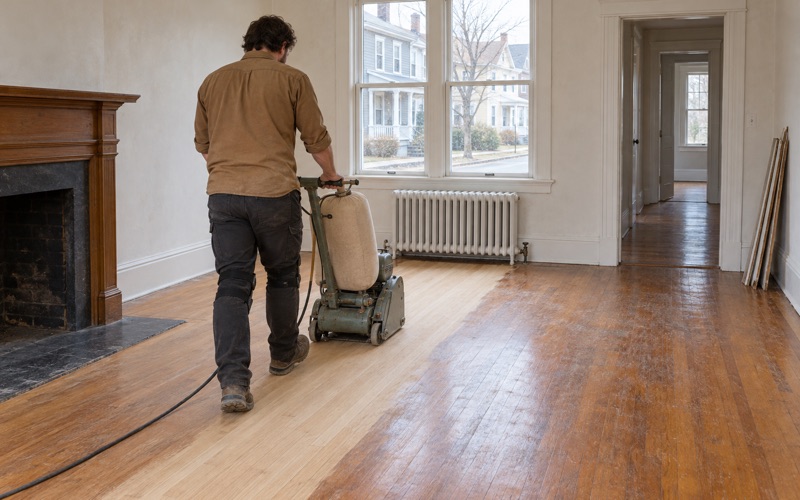
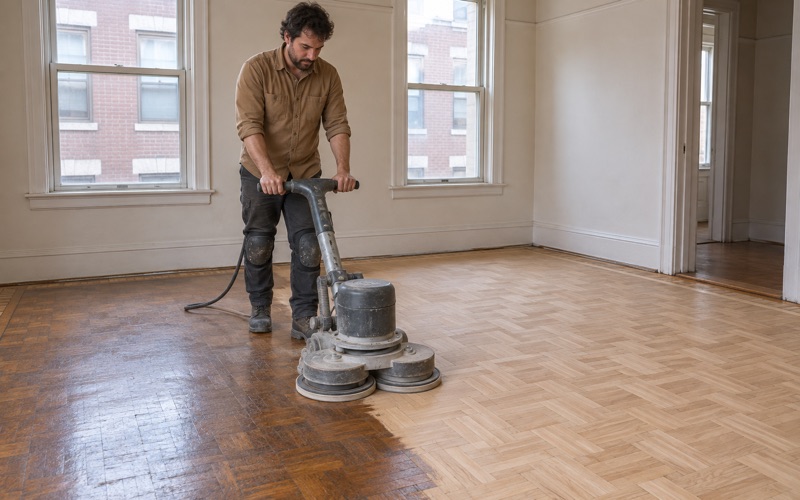
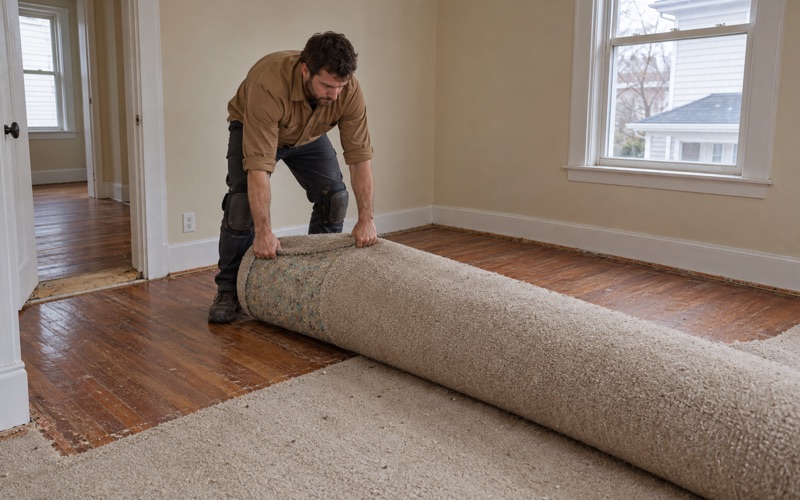
Plenty of the oak in these blocks has spent decades under carpet, linoleum or paint. Before a drum sander is switched on we strip the pad, the staples, the tack strip and any adhesive, black mastic included, so the first pass is cutting wood rather than dragging glue across the room.
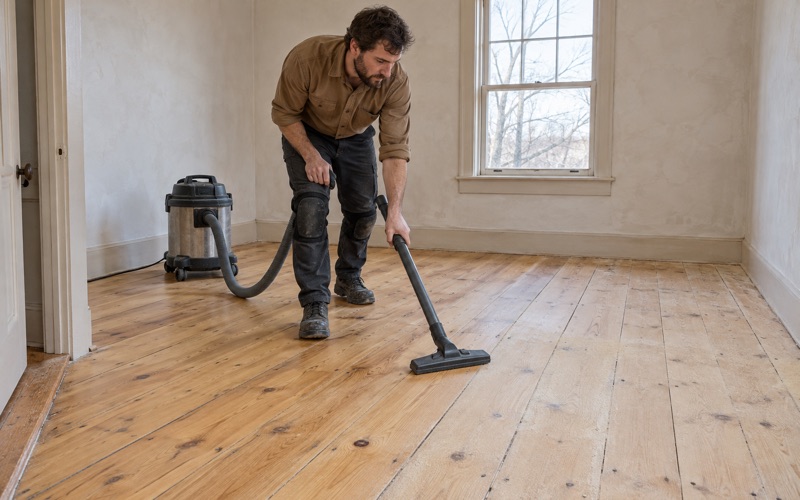
We work dustless wherever the building allows it, with the sander ported to a HEPA vacuum, and we run a full grit sequence instead of trying to bring a floor back in two passes. Face-nailed boards and old cut nails get set below the surface first, because one proud nail head is what takes the belt off a drum sander.
Measuring What Is Left to Sand
Old pine and early oak hold a finite number of sandings, and a floor already taken down four times has very little left above the tongue. We measure remaining thickness before promising a full sand, and when the answer is no we say so and price a screen and recoat, selective board replacement, or a new floor instead.
The same check governs engineered floors. We measure the wear layer before anyone assumes it can be sanded, because a thin veneer over plywood is a one-shot proposition at best. We also decline to write a species into an estimate before seeing the floor, since red oak, white oak, maple and eastern white pine each take a stain differently.
Looking for wood-flooring closer to Amesbury? See Wood-Flooring Services in Amesbury.
What Newburyport Rebuilt After the 1811 Fire
The district around Market Square was completely rebuilt after a major fire in 1811. What went up afterward was shaped by a building code adopted in the fire’s wake, one that required brick construction or put size limits on wood-frame buildings, and the dense run of Federal brick that resulted is still what defines these blocks.
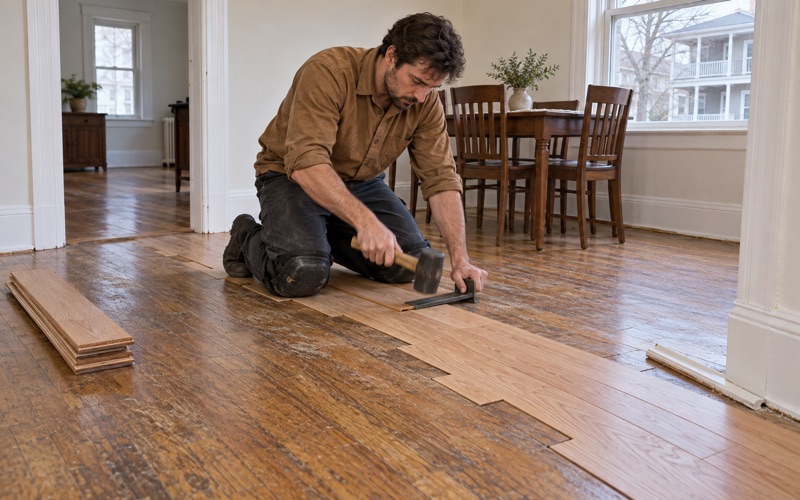
For us that history sets the working conditions. Interior partitions, stair runs and floor framing in those buildings follow their own era’s habits rather than a modern standard, so board widths change from room to room, thresholds sit at different heights, and a patch has to be fitted to what is actually there rather than ordered off a chart.
Old Floors Above the Shops
Many of these buildings held trade at street level and rooms above from the beginning. Upper floors in a mixed-use building take a different kind of wear than a single-family house: traffic lanes worn along one route between door and stair, nosings worn round on the treads, and rooms divided and re-divided as tenancies changed.
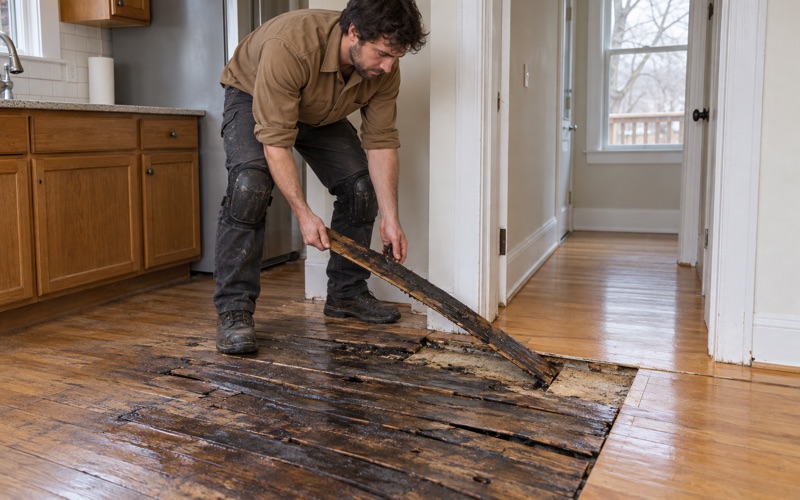
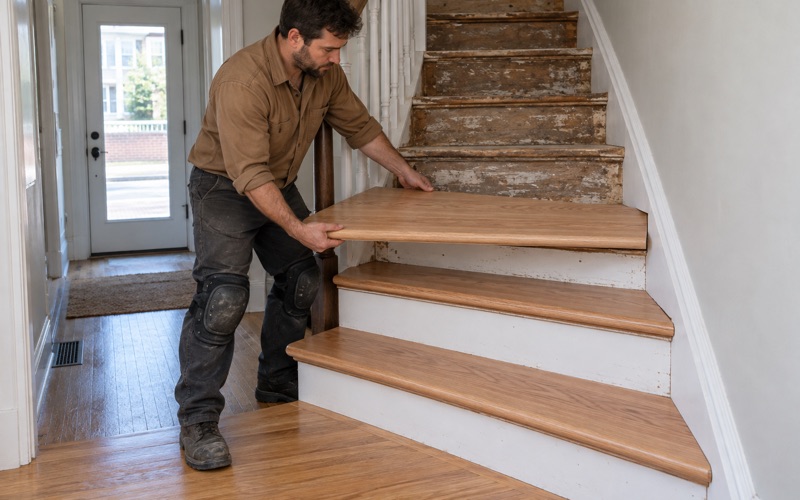
Stairs are quoted by the tread and the riser on our estimates and never folded into a square-foot number, because a staircase is joinery and a floor is a surface. Where old steam radiators and their risers have been pulled out, we weave matching boards into the opening rather than filling it, since a filled radiator patch stays visible from the doorway for the life of the floor.
Build Year, Paint and the Lead Rules
Citywide, 44.9 percent of Newburyport’s housing units predate 1940, and that is the assumption we start from until a specific building tells us otherwise. We read the build year and every painted surface in the work area before the sander is switched on, because Massachusetts runs its own lead-safe renovation rules on housing built before 1978 and floor sanding is squarely the kind of work they address.
That reading governs containment, cleanup and how we handle painted baseboard, thresholds and stair parts in the room. It is a sequencing question far more than a cost question, and it is much cheaper to answer before the first pass than after it.
Two Newburyport Listings, Two Different Kinds of Building
Newburyport carries more than one National Register listing, and they are not the same thing. Market Square went on the Register in 1971; the much larger Newburyport Historic District is a separate listing made in 1984 across a far wider area of the city. The two are easy to mix up, and treating them as one listing leads owners to the wrong conclusions about their own building.
The practical difference for a floor is construction type. Market Square is a brick commercial core rebuilt to a post-fire code, while the wood-frame houses elsewhere in the city come from a different building tradition, and a floor framed inside a masonry shell does not move the way a floor in a timber-framed house does.
What Review Reaches, and What It Does Not
Newburyport is a city in Essex County, set off from Newbury as a town on January 28, 1764 and a city since 1851, and its historic framework has accumulated in layers since. Massachusetts historic district review under M.G.L. c.40C, and Newburyport’s own district layers, are aimed at exteriors and at demolition.
Sanding, patching or replacing a floor inside a building is not what those layers are looking at. Condominium bylaws are another matter entirely and frequently do speak to underlayment and rug coverage in a multi-unit building, so we read them before scheduling rather than after.
The Coastal Air the Floor Lives In
Newburyport sits in the National Weather Service Essex County coastal forecast zone, MAZ007, under the Boston forecast office, rather than the western Essex zone its neighbors inland fall into. Coastal humidity swings drive most of the seasonal movement we are called about: boards that cup through a wet stretch, gaps that open in a dry heated one, and crowning on a floor that was sanded flat while it was still carrying moisture.
So we meter. A moisture meter reading on the boards and the subfloor decides when we sand and when we wait, and new material acclimates in the room it will live in rather than in a van. Where storm water or a burst pipe has come in, we trace it back to the entry point, dry the assembly and meter it before a single board comes up, and we photograph and measure the wet rooms for the adjuster while the floor is still wet.
Planning a Floor Job in Downtown Newburyport
About 77.5 percent of Newburyport households own their home and the remaining 22.5 percent rent, which in practice means two different kinds of job on our calendar. An owner-occupied floor is scheduled around the people living on it; a rental floor is scheduled against the window between one tenant moving out and the next one signing.
We turn vacant units around inside that window when the dates are set early, and we work occupied buildings one level at a time so the rest of the building stays in use while a single floor is out of service. In a downtown building with a tenant at street level, that sequencing is most of the job.
Finish Choices, and What They Cost in Time
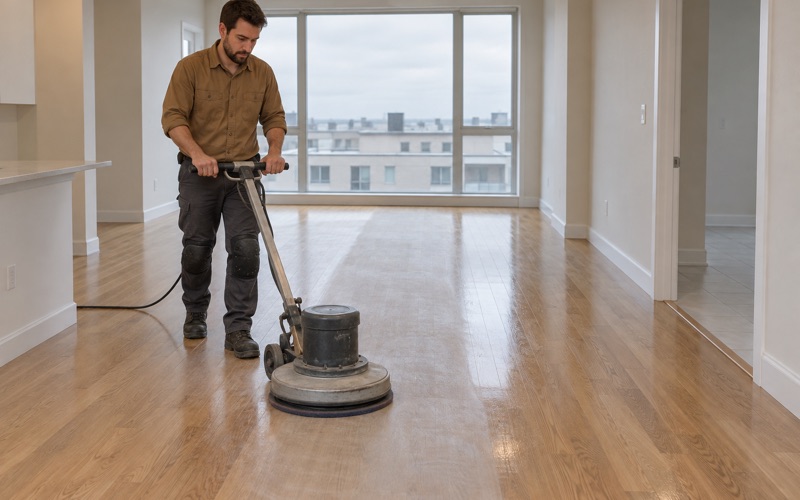
Finish is where the schedule is really decided. Waterborne polyurethane returns a room to use sooner and stays clear; oil-modified polyurethane ambers over the years and wants longer between coats; hardwax oil is repairable in place but asks for a different maintenance habit. Sheen level is a separate decision again, and it changes how much traffic a floor shows.
Everything we use is chosen against the Massachusetts coating limits, which are tighter than the federal ones, so the shortlist here is narrower than a national product page suggests. We put stain samples down on your own boards instead of handing over a fan deck, and where a stain has to take evenly we water pop the surface first.
What to Send Us Before the Visit
Photographs of the floor, of any stained or damaged area, and of the stair when one is in scope tell us most of what we need to price a visit properly. If you know roughly when the building went up, whether the floor has been sanded before, and what currently sits on top of it, say so, because those three answers move an estimate more than the square footage does.
From there we walk the floor, meter it, check what thickness remains, and hand back a sequence with dates rather than a range. Pet urine stains, water stains, board gapping and insect damage from powderpost beetle or carpenter ants are all called out before the work starts, not discovered halfway through it.
- 20+ Years on New England Floors
- Free Written Estimates
- Dustless Sanding