Revere Wood Flooring has been doing wood-flooring in Nahant for more than twenty years: sanding and refinishing boards that are older than the furniture standing on them, weaving repairs into rooms where something was pulled out and never patched, and laying new hardwood where carpet has finally come up for good.
Nearly everything we are called for is one of three jobs. A floor still has enough material in it to be sanded and finished again, or it needs damage handled in one or two rooms and blended into the rest, or it has nothing left to give and comes out. Which of those applies is a measurement rather than an opinion.
So we open with the measurements and quote afterward. Build year, remaining thickness in the boards, moisture readings taken in more than one room, and whatever is nailed or glued underneath decide the scope. The schedule follows that, never the other way around.
The Forty Steps Beach Bluff Project and the Road Beneath It

Shoreline damage here is not a vague background risk, which is unusual. A significant storm in March 2018 caused damage and severe erosion to the existing seawall and revetment at Forty Steps Beach, and the town has been moving the repair through the state ever since.
The Town received an initial resiliency planning grant in October 2022, and in October 2023 the Massachusetts Office of Coastal Zone Management’s Coastal Resilience Grant Program awarded $147,295, matched with $38,650 in town funding, to seek permits for cobble nourishment and vegetation planting at Forty Steps Beach. The stated purpose is to stabilize the eroded bluff and protect the critical roadway and utility infrastructure beside it.
Cobble and Planting, Not a Taller Wall
Cobble nourishment and vegetation planting are a different sort of answer than more concrete. Stone is placed to take the energy out of wave run-up and plant roots are used to hold the bank together, which establishes slowly and is maintained rather than finished.
For a homeowner the part that matters sits behind the bluff. The adjacent Nahant Road carries critical public utilities and is an essential access and emergency road for those in east Nahant, which is why stabilizing that bank reads as infrastructure work rather than beach work.
One Project, Not the Whole Shoreline
A second effort gets confused with this one, so we keep the two apart. In February 2025 the town announced a $3.5 million grant to stabilize and restore the dunes along Short Beach — a different beach, a different funding source, a different scope. Neither award covers the whole shoreline, and no single figure describes what has been repaired.
What it changes about our end of the work is small but real. In a town that has spent years documenting storm damage, homeowners usually know where water has come in before, and that history is worth ten minutes of conversation before anyone quotes a floor.
Roadway and utility work also tends to arrive in clusters. When a bank is being rebuilt or a street is opened for the services running under it, delivery access and dumpster placement are worth confirming a few days ahead rather than the morning of, and we would rather move a start date by a day than have a truck of white oak circling.
Looking for wood-flooring closer to Winthrop Town? See Winthrop Town Wood-Flooring.
Older Houses With Their Owners Still In Them
The housing stock is genuinely old. Of 1,814 units, 957 — 52.8 percent — were built in 1939 or earlier, and 1,605, or 88.5 percent, predate 1980. Barely four percent went up in 2000 or later. Each of those decades left a different floor behind.
It is also a town of single houses occupied by the people who own them. One-unit detached houses account for 1,280 of the 1,814 units, just over 70 percent, and 88.5 percent of owner households live in one. Old house plus long tenure is why so many floors we look at have been sanded before, sometimes more than once.
Reading What Is Left Before the Sander Starts
Eastern white pine and early red oak do not carry unlimited material above the tongue. We measure what is left before anyone commits to a full sand, because a floor taken down three times may only have a screen and recoat in it — and on an engineered floor we measure the wear layer instead of promising a sanding it cannot survive.
Species and grade decide what a floor looks like when it comes back. Red oak takes stain readily and reads warm, white oak is tighter and cooler under the same can, and maple resists stain enough that it is usually better finished clear. Where rift and quartersawn or select grade boards were laid in a front room, we keep the cut conservative so that grain is still doing its work afterward.
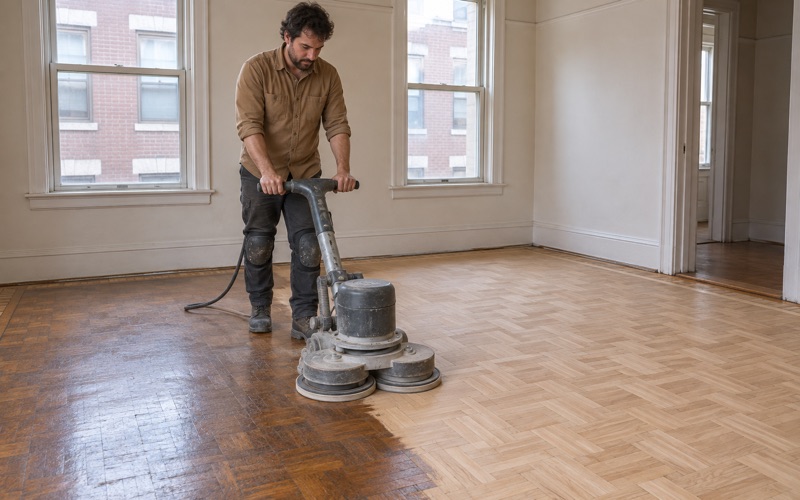
Cut nails and face nailing in the oldest rooms, board gapping that opens every heating season, hollow spots where the subfloor has moved, traffic lanes worn through to bare wood: those are the ordinary findings at this age and all of them are workable. Parquet and herringbone turn up in later rooms and take their own grit sequence, run at an angle that ignores the long dimension of the room.
Paint, Dust and the 1978 Line
Massachusetts runs its own lead-safe renovation rules on homes built before 1978, and where 88.5 percent of units predate 1980 that is the default assumption rather than the exception. We read the build year and the painted surfaces — baseboard, stair risers, thresholds — before the sander is switched on, and containment and cleanup are part of the schedule rather than an afterthought.
Sanding runs with HEPA vacuum extraction on the drum sander, the edger and the buffer. Nothing is truly dustless, but in an occupied house with original molding it is the difference between cleaning a room and cleaning a house.
What Turns Up Under Carpet and Linoleum
Where carpet comes up we remove pad, staples and tack strip before any grit touches wood, and where linoleum has been down for decades there is usually black mastic beneath it that has to come off rather than be sanded into the abrasive. Old radiator and riser openings get woven-in patches in matching boards — red oak to red oak, pine to pine — instead of a trowel of filler that reads as a scar under any sheen.
Two findings stop a job rather than slow it. Powderpost beetle exit holes in old pine or early oak, and carpenter ant galleries in a bay that has stayed damp, both belong to another trade before they belong to us. We will sequence around the treatment and patch the boards afterward, but sanding over active insect damage only hides it for a season.
When Water Reaches the Floor
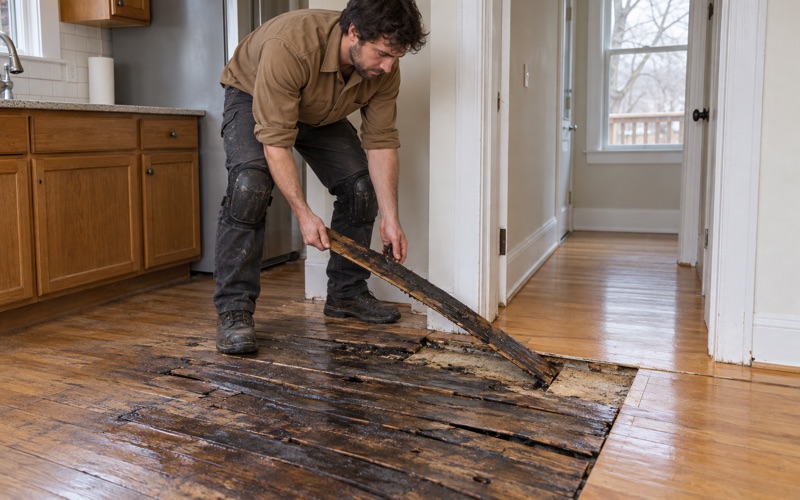
Storm surge, wind-driven rain and a burst pipe all end the same way on wood, and the sequence we follow is the same for each: trace where the water entered, stop it, dry the structure, and meter it before a single board is pulled.
Cupping, where boards rise at their edges, is the first sign and usually means moisture is still underneath. Crowning is what a cupped floor becomes when it is sanded flat before it has dried, and buckling is the extreme case, boards lifting away from the subfloor. Sanding early is the mistake that costs the most.
Metering, Drying, Then Deciding
We take readings across the wet rooms and in dry rooms as a baseline, then again over several days, and sanding is not scheduled until the numbers settle near where that house normally lives. A floor allowed to dry slowly often flattens on its own and needs far less taken off it.
While the rooms are still wet we photograph and measure them for the adjuster. A file assembled after the floor is already out is a much weaker file, and this is one of the few points in the job where waiting costs the homeowner money.
Repair Before Replacement
Most water events are local. Board replacement in the affected area, feathered into the surrounding field and matched with stain samples before any finish goes down, usually beats replacing an entire floor — particularly with old-growth boards that cannot be bought new in the same width.
Planning the Job From Delivery to Final Coat
Access is narrow and the town is small, so deliveries, equipment and debris removal are planned for a specific window instead of a truck sitting outside for two weeks. Material comes in ahead of the work to acclimate inside the house, which matters on a coastal lot where indoor humidity swings hard between August and January.
Expansion gaps go in at every wall and under every threshold for the same reason. Winter gaps between boards in a heated house are normal and close again in summer; a floor laid tight with nowhere to move is the one that buckles.
Finish, Sheen and the Coating Limits
Massachusetts sets its own limits on what a floor coating may contain, and they are tighter than the federal ones, so a product a homeowner reads about elsewhere is not always one we can use here. There is still plenty of room inside them: waterborne polyurethane for a fast return to service and little ambering, oil-modified polyurethane where someone wants the warmer tone on red oak, hardwax oil where a repairable surface matters more than maximum abrasion resistance.
Sheen is chosen in the room rather than off a card. Stain samples go down on the actual floor, and where a darker color is going on oak we water-pop first so it takes evenly instead of blotching along the grain.
Keeping a Floor Out of the Sander
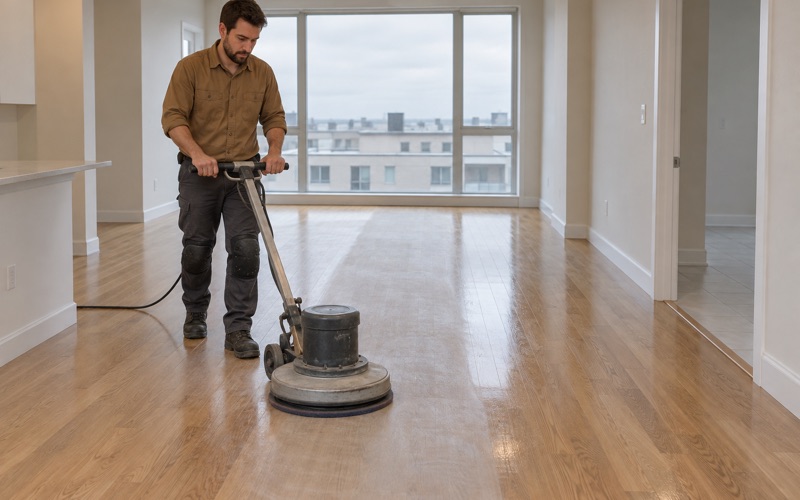
A floor that gets a screen and recoat before the finish wears through never needs another full sand, and in a house where the boards are already thin that is close to the whole game. We say so when a floor is still a candidate for it.
We say so just as plainly when it is past that point, when the wear has gone into the wood in the traffic lanes and the only honest answer is to take the room back to bare board once more.
Stairs, Two-Families and Vacant Units
Stairs are quoted by the tread and the riser and never folded into a square-foot number. Treads, risers and nosings are separate pieces of work, and pricing them as floor area is how a quote turns into an argument.
In a two-family house we run one floor at a time so the other household stays put while the work goes on, and where a unit is empty between tenants we work to the date it has to be ready rather than to our own convenience. Either way the scope, the drying time and the finish schedule are settled before we start, and the rooms come back on the day we said they would.
- 20+ Years on New England Floors
- Free Written Estimates
- Dustless Sanding