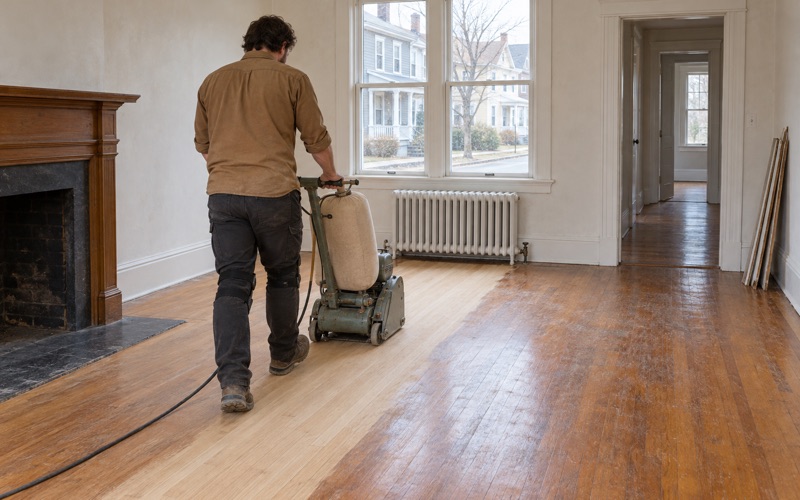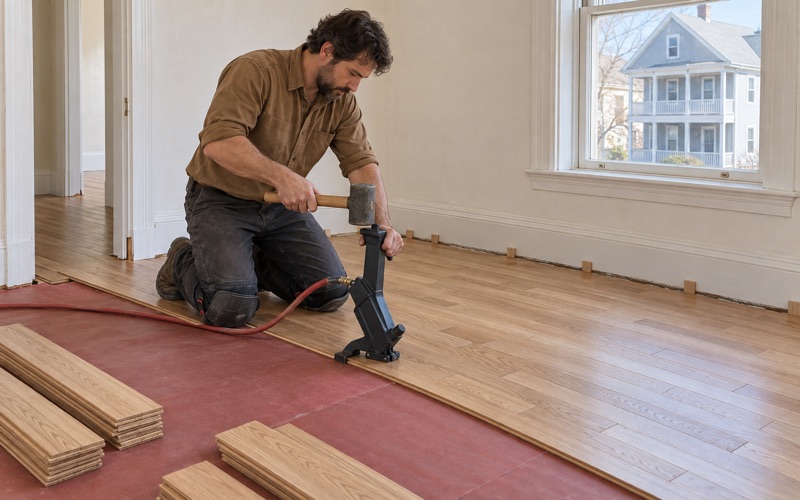
Revere Wood Flooring has spent more than twenty years on wood flooring in Lynnfield: sanding and refinishing what is already down, replacing boards that have failed, and weaving repairs into a surface so the fix does not read as a patch. Most of that work happens in single-family houses, and most of it is solid strip flooring carrying twenty or thirty years of traffic since its last finish.
What varies from house to house is not the machine but what the machine is being asked to do. A floor with plenty of thickness left takes a full sand and a new finish; a floor that has already given up most of what sits above the tongue takes a recoat, or a repair plan, and we would rather say so at the estimate than halfway through the second grit.
So the first visit is measurement. We check remaining thickness at a threshold or a register cut, take moisture meter readings at several points in the room and in the subfloor, look at how the boards are fastened, and quote the field, the stairs and the repairs as separate lines rather than one square-foot number.
Old Floors and the Common: What Lynnfield Actually Has

Lynnfield reads from the road like a much older town than its housing data says it is. Only 616 of the town’s 4,597 housing units, 13.4 percent, were built in 1939 or earlier, so genuinely old floors here are a small and scattered set rather than the rule. Assuming otherwise is how a floor gets sanded that should have been measured first.
The densest cluster sits around the town common, in the Meetinghouse Common District, bounded by Summer, South Common and Main Streets and added to the National Register of Historic Places on November 21, 1976. Along with the Meeting House, fifteen nearby religious, civic, commercial and residential buildings and sites are included in the district, in Greek Revival and Colonial styles.
The 1714 Meeting House at its center is the second-oldest Puritan Congregationalist meeting house still standing in Massachusetts, after the Old Ship Meeting House in Hingham, built in 1681. Buildings of that vintage set the tone for how we handle floors in the houses near them, which is cautiously and with a tape measure before a sander.
Reading a floor that has been sanded before
A solid floor gives up a little thickness every time it is refinished, and one that has been through four passes has very little left to give. We find a cut edge at a register, a heat line or a doorway and measure there, because that number decides whether the job is a full sand, a screen and recoat, or board replacement in the worn traffic lanes.
Hollow spots and movement underfoot usually point at fasteners rather than finish. Older work is often face-nailed with cut nails that have worked loose in the joists, and a floor refastened and flattened first will hold its coating far longer than one sanded smooth and left to shift.
Damage that sits under the finish
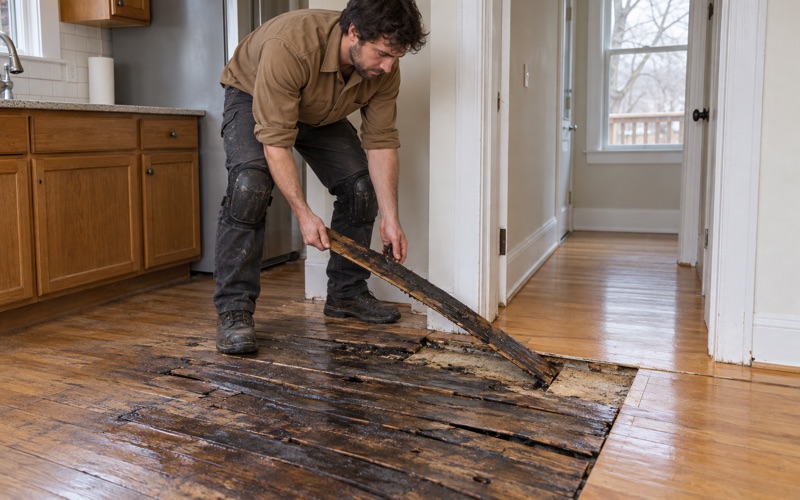
Powderpost beetle galleries, water stains that have traveled into the wood instead of sitting in the coating, and board gapping wide enough to catch a heel are conditions no sander corrects. We identify them during the estimate and price the board replacement or weave-in repair on their own line, so the finish work is not quietly carrying a structural problem into the invoice.
Looking for wood-flooring closer to Roxbury? See Wood-Flooring Services in Roxbury.
The Demolition Delay Bylaw, and What It Does Not Reach
Lynnfield keeps a second layer of historic oversight that does not follow the district map. The Lynnfield Historical Commission, founded in 1963 as a five-member board appointed by the selectmen, maintains a Demolition Delay Bylaw together with its own updated property list, and that list reaches buildings standing well outside the Meetinghouse Common District.
Homeowners sometimes assume that a National Register district or a spot on that property list puts their floors under review. It does not. Neither the district listing nor the bylaw’s list is aimed at interior finish work, and sanding a floor, swapping damaged boards or changing a stain color inside your own house is not what either one was written to govern.
We are also not the people to interpret the bylaw’s terms for you. The Commission publishes the bylaw and keeps its property list current, and questions about the building itself belong there. What we can say is that nothing in a Lynnfield floor estimate turns on either document.
Older houses outside the mapped district
Because the property list and the district boundary do not overlap neatly, the pre-1940 floors we work on are spread around town rather than gathered in one place. A house on a back road gets the same read as one a short walk from the common, and the read does not change because of what is on a plaque outside.
That read is the same in both settings: remaining thickness, fastener condition, subfloor movement, and whatever is hiding under the current surface. Carpet, linoleum and adhesive-set tile all turn up over old boards, and the first thing off the floor is pad, staples, tack strip and black mastic rather than wood.
What the age actually changes
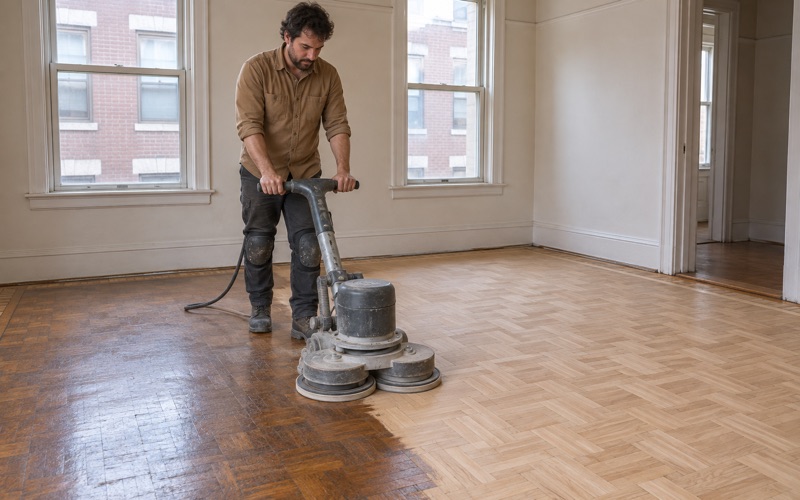
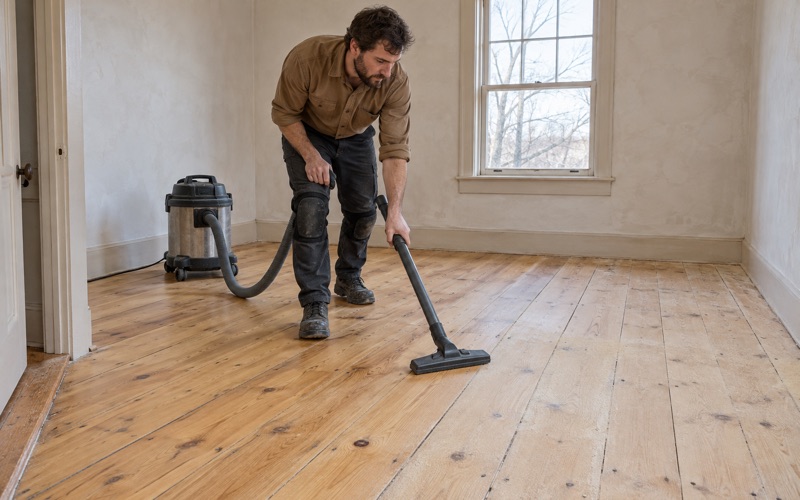
Age shifts the sequence more than the tool list. The first cut waits until the floor is refastened and flat, the grit sequence stays tight so the final pass is not chasing scratches left by the first, and everything runs through dustless sanding with HEPA extraction, because an old house holds enough dust already without a drum sander adding to it.
Refinishing Floors in Lynnfield’s Postwar Houses
The bulk of the town went up after the war. Of those 4,597 units, 1,008 were built in the 1950s and another 800 in the 1960s, and 3,759 of them, 81.8 percent, are one-unit detached houses. Owners occupy 87.3 percent of the occupied units, so most of these floors are being refinished by the people who then have to live on them.
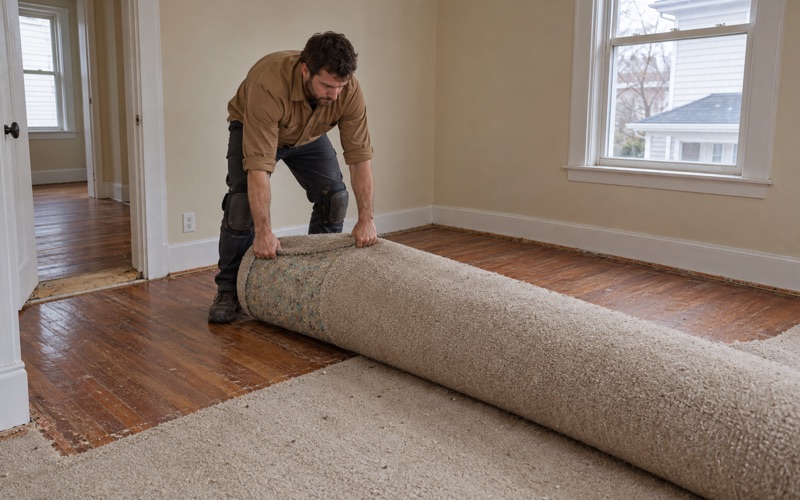
Those floors are often in better condition than their age suggests, because many of them spent decades under carpet. What surfaces when the carpet comes up is pad residue, staples every few inches along the seams, tack strip nailed around the perimeter, and a clean finish line where the shoe molding used to sit.
Recoat or full sand
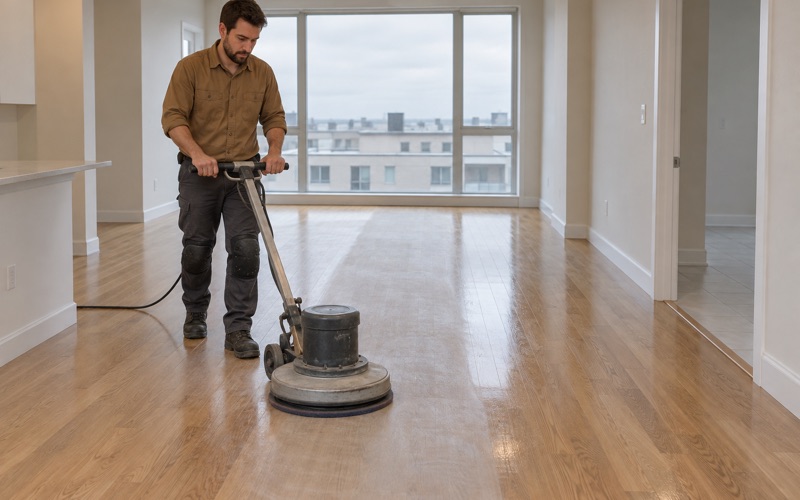
Not every floor needs to go back to bare wood. Where the coating is worn but the wood beneath it is sound, a screen and recoat abrades the existing finish and lays a fresh one over it, in a fraction of the time and with a fraction of the disruption.
A full sand is the answer when gray is showing through the traffic lanes, when pet urine stains have reached the wood, or when an old finish is failing in sheets rather than thinning evenly. Which one your floor needs is something we decide standing on it, not from a description over the phone.
Finishes and the Massachusetts coating limits
Finish selection here starts with the Massachusetts coating limits under 310 CMR 7.25, which are tighter than the federal ones and narrow the field before anyone’s preference enters the conversation. Waterborne polyurethane, oil-modified polyurethane and hardwax oil each behave differently in amber tone, cure time and how they hold up in a hallway.
Color gets decided on your floor rather than on a chart. We lay stain samples on the sanded wood, water pop where the species and the stain call for it, and let you choose the sheen level in the room itself, under the lights you actually use at night.
Build year before the sander
More than half of Lynnfield’s housing stock was in place before 1970, which puts most of these houses on the older side of the 1978 threshold Massachusetts uses for its own lead-safe renovation rules. We read the build year and the painted surfaces, including baseboard, shoe molding and stair parts, before a machine is switched on rather than after.
Planning a Floor Job in Lynnfield
Timing matters more than people expect. The National Weather Service groups Lynnfield into its coastal Essex County forecast zone, MAZ007, and the indoor swing between a humid August stretch and a dry heated week in February is enough to move a floor without any help from us.
Winter gaps between boards in a heated house and mild cupping during a damp month are normal seasonal movement rather than defects. Both are worth understanding before the work starts, which is why moisture readings in the room and in the subfloor come before we commit to a date on the calendar.
Acclimation and new material
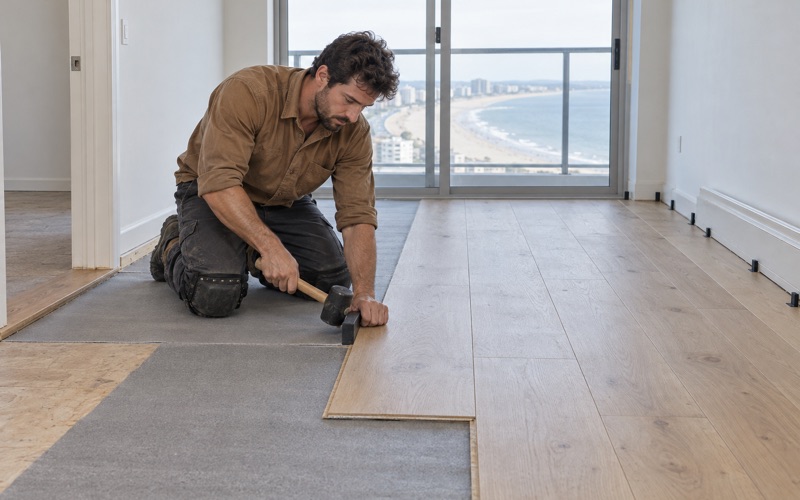
Any new wood entering the house, whether that is a handful of replacement boards or a full room, sits in the space until its moisture content matches what is already down. We leave an expansion gap at the walls and under the thresholds and cover it with baseboard or quarter round, rather than filling it and watching it push later.
Species matters to that plan as much as to appearance. Red oak, white oak and maple take stain differently and sit at different points on the Janka hardness scale, and a weave-in repair looks right only when the new material is matched to what surrounds it in both grain and cut.
Stairs, thresholds and trim
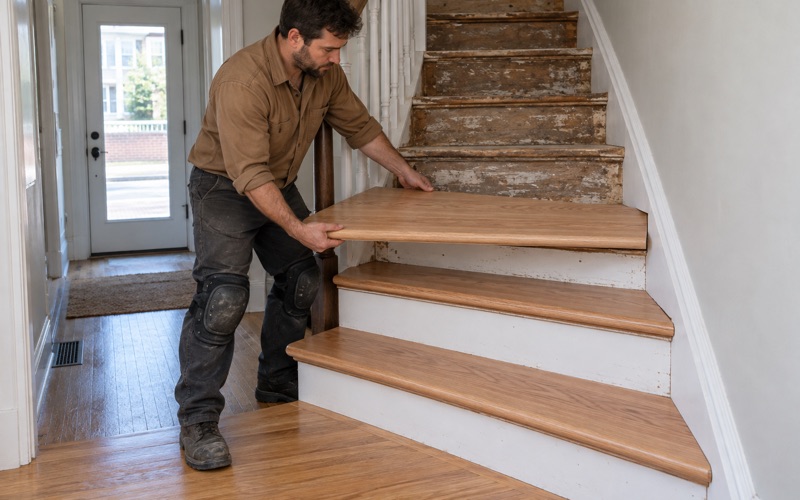
Stairs are quoted by the tread and the riser and never folded into a square-foot figure, because a staircase is a dozen small refinishing jobs with nosings, returns and balusters in the way of every one of them. Reducers and thresholds where wood meets tile or carpet are handled on the same basis.
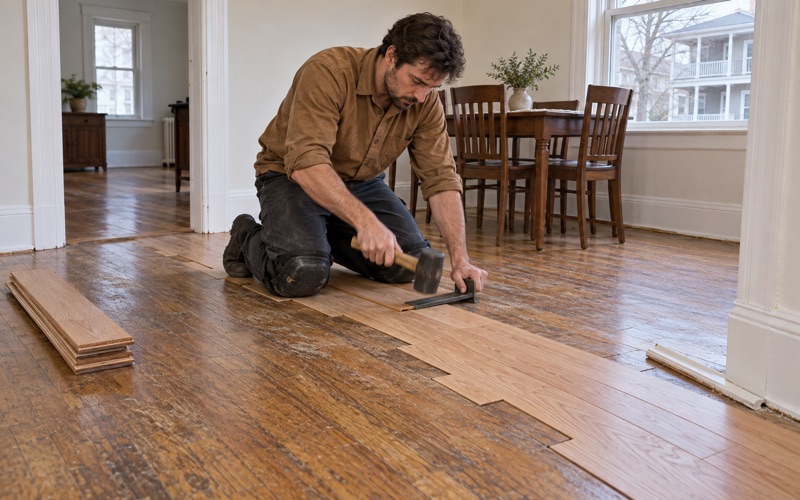
Where an old steam radiator or a riser came out and left a hole in the field, we patch it with matching boards woven into the surrounding courses instead of filling it. A filled patch announces itself the first time low afternoon light crosses the room.
What we check before quoting
If your floor is engineered rather than solid, we measure the wear layer before anyone promises it can be sanded, because a good deal of engineered product does not hold a single full pass. Prefinished and site-finished floors also part ways here, since one has beveled edges and a factory coating and the other does not.
All of it lands in a written estimate with the field, the stairs and the repairs on separate lines, alongside a schedule that says which days are dusty, which days are wet, and when the furniture can come back. That is the whole of what we ask you to decide from.
- 20+ Years on New England Floors
- Free Written Estimates
- Dustless Sanding