Revere Wood Flooring has been sanding, repairing and installing wood flooring in Lynn for more than twenty years, and most of that work happens in buildings that went up long before anyone wrote down how a floor was supposed to be kept. The floors themselves are usually worth saving. What varies from address to address is how much of one is left, and what has been done to it since.
Our work in the city splits roughly three ways. There is whole-house refinishing for owners of two-family and single-family houses, board repair and weave-in patching where a floor has been opened up or ruined in one spot, and quick turnarounds on units that have to be back in service on a date somebody else already set.
Every estimate starts with the floor in front of us: species, remaining thickness above the tongue, the fasteners holding it down, and a moisture meter reading. Not a square-foot price quoted sight unseen. In Lynn that is less caution than arithmetic, and it follows from what the housing stock here actually is.
What a State Audit of Lynn’s Public Housing Recorded
The Massachusetts Office of the State Auditor reviewed Lynn Housing Authority & Neighborhood Development over a period reported as July 1, 2005 through December 31, 2008. The finding worth knowing about, for anyone responsible for an older unit, was not about a particular building. It was that the Authority “did not conduct annual dwelling unit inspections as required by the Department of Housing and Community Development Property Maintenance Guide.”
A Standard of Once a Year, and Again at Every Vacancy
That guide sets two clocks running on the same unit. One is the calendar: every dwelling unit is to be inspected annually. The other is occupancy: the unit is to be inspected again whenever it empties out, before the next household moves in. The audit’s point was that the standard existed in writing and was not reliably being met on the ground.
What the Auditors Wrote Down
For the fiscal year ended June 30, 2005, auditors examined 24 of the Authority’s 389 state-aided housing units and recorded 19 instances of noncompliance with Chapter II of the State Sanitary Code, including peeling paint on walls and ceilings, mold and mildew. Seventeen building exteriors turned up 34 more. A prior audit cited in the same review had found 53 instances, among them peeling paint, obstructed entrances, mold and mildew, deteriorated and crumbling concrete stairways, and roof leaks.
Two things about that list need separating out. It is a historical record of one stock of state-aided housing, not a statement about conditions in any unit today, and not a description of Lynn’s private rentals, which the city’s Inspectional Services Department handles under a separate 2020 ordinance calling for yearly registration and an inspection every five years. And floors are not on the list at all: what the auditors named was paint, mold, mildew, stairways and roofs.
It is still a floor list by another route. Peeling paint, mildew and a roof leak are one story told at three heights, and the floor is where that story finishes. A unit sitting empty between tenants wears in exactly those ways, which is why the first thing we do in a vacant room is look up before we look down.
Looking for wood-flooring closer to East Boston? See Wood-Flooring Services in East Boston.
Prewar Floors, and What Lynn Built in a Hurry
Of Lynn’s 37,960 housing units, 17,360 were built in 1939 or earlier: 45.7 percent of everything standing. A good share of that arrived in one burst. More than 850 three-decker apartment buildings went up across the city between 1905 and 1913, the majority of them in the Brickyard, the working-class immigrant quarter just west of downtown.
What That Era Put Down
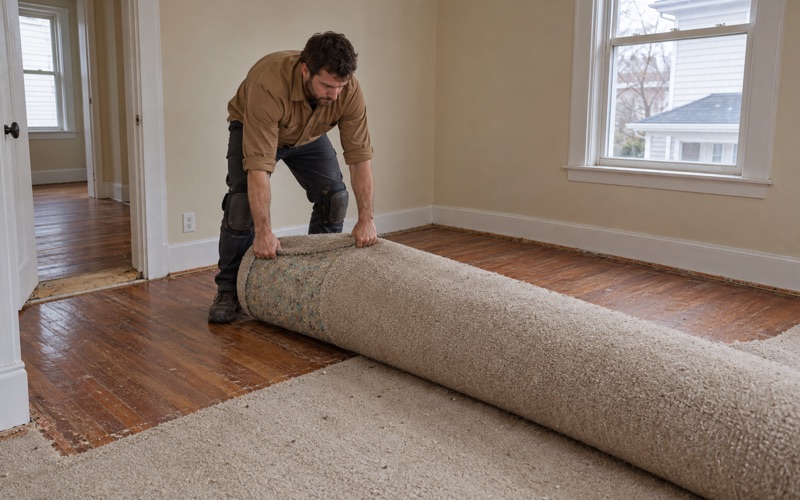
Floors from those years are usually eastern white pine or early red oak, narrow, face nailed or set with cut nails, and finished in shellac that has gone orange under a century of daylight. Many were covered later, linoleum in one decade and carpet in the next, so the first day’s work is often pad, staples, tack strip and black mastic rather than sanding. None of that comes up cleanly, and a floor sanded with adhesive still on it is a floor with the adhesive ground into the grain.
How Much Floor Is Left
Old pine and early oak get one honest answer before anything else: how much wood sits above the tongue. A board sanded three or four times over its life has very little left to give, and we check it at a threshold or a register opening before quoting a full sand. Where the answer is not enough, board replacement in matching stock, or a screen and recoat, does more for the floor than another pass under a drum sander.
Painted Surfaces Come First
Baseboard, molding, door casings and stair risers in a building this old were painted well before 1978, and Massachusetts runs its own lead-safe renovation rules on homes built before that year. We read the build year and the painted surfaces in a room before the sander is switched on. In a stock where nearly half the homes predate 1940, that is the ordinary case here rather than the exception.
Refinishing a Unit Between Tenants
Lynn has 36,414 occupied housing units, and 18,892 of them, 51.9 percent, are rented. A unit standing empty between households is the only window in which floor work is possible at all, and it is the same window the painters, the plumber and the cleaners are competing for.
Find the Water Before the Finish
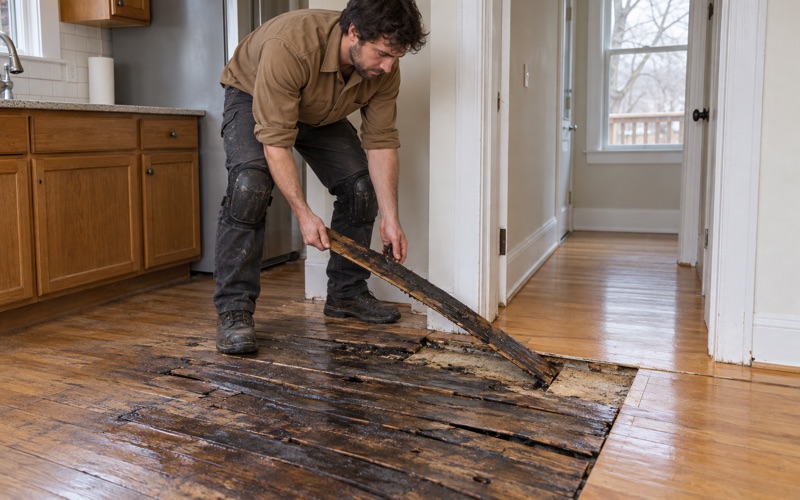
Cupping across a room, crowning where someone flattened a cupped floor too early, board gapping wider than ordinary winter gaps, dark water stains along a wall, pet urine stains gone black in the grain: each is a symptom with a source, and the source is usually still in the building. We trace storm water, surge or a burst supply line back to where it came in, dry it, and meter it before a single board is pulled. Where there is a claim to make, the room gets photographed and measured for the adjuster while the floor is still wet.
Sanding While the Building Stays Occupied
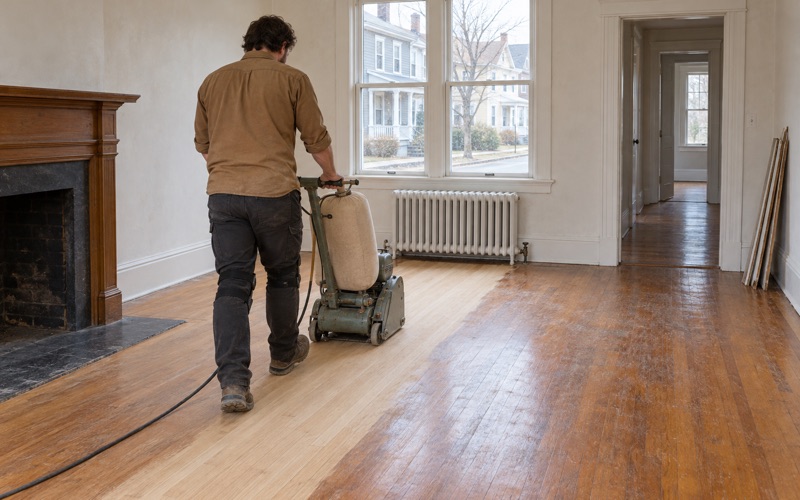
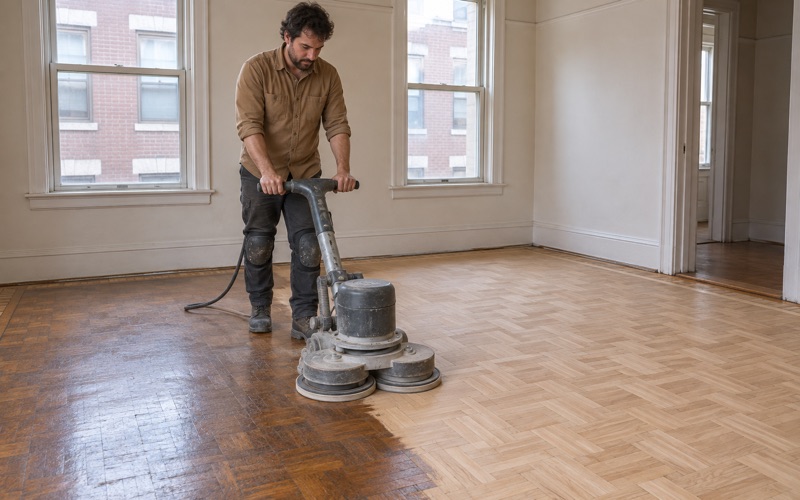
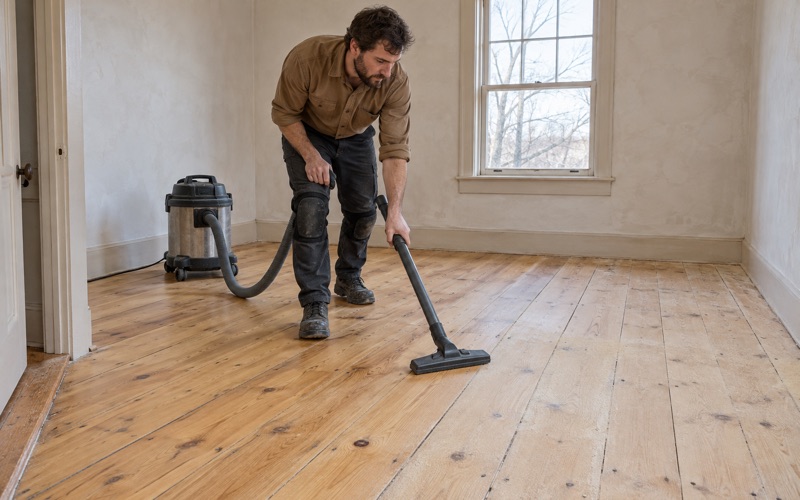
One empty unit rarely means an empty building. We run dustless sanding with a HEPA vacuum on the machine, keep the grit sequence tight so the drum sander does less cutting than it otherwise would, and bring the perimeter and closets up with an orbital and a buffer. In a two-family we take one floor at a time, so whoever lives on the other floor stays in the house while the work runs.
The Finish, and the Massachusetts Limits
Waterborne polyurethane turns a unit around faster and stays clear over red oak; oil-modified polyurethane ambers and wants longer between coats; hardwax oil suits a floor that will be maintained in place rather than resanded. Massachusetts holds coatings to tighter limits than the federal rules under 310 CMR 7.25, so what goes down here is chosen against the state list before the calendar is drawn up. Stain samples are laid on the actual floor, and water popping is decided in advance where a dark color has to take evenly across old and new boards.
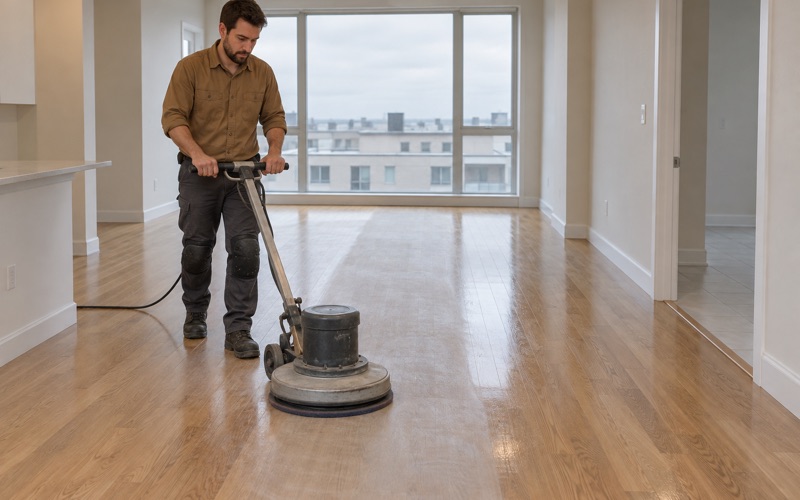
When the wear layer is sound and only the finish is spent in the traffic lanes, a screen and recoat puts a unit back in service in a fraction of the time a full sand takes, and spends none of the floor’s remaining thickness.
Planning the Job Around the Building
Lynn’s buildings are not one thing, and the work changes with the number on the mailbox. There are 5,873 units in two-unit houses and 6,453 in three- and four-unit buildings, while another 4,194 sit in buildings of fifty units or more.
Larger Buildings Have Their Own Rules
A building at that scale usually carries its own conditions in the condominium bylaws: rug coverage over some share of the finished floor, a required underlayment, hours when noisy work may run. We book around those rather than meeting them at the door on the first morning. In elevator buildings the schedule is written to the freight elevator and the loading dock, with the household directly below the room being sanded accounted for in the sequence.
Stairs and the Parts That Are Not Square Feet
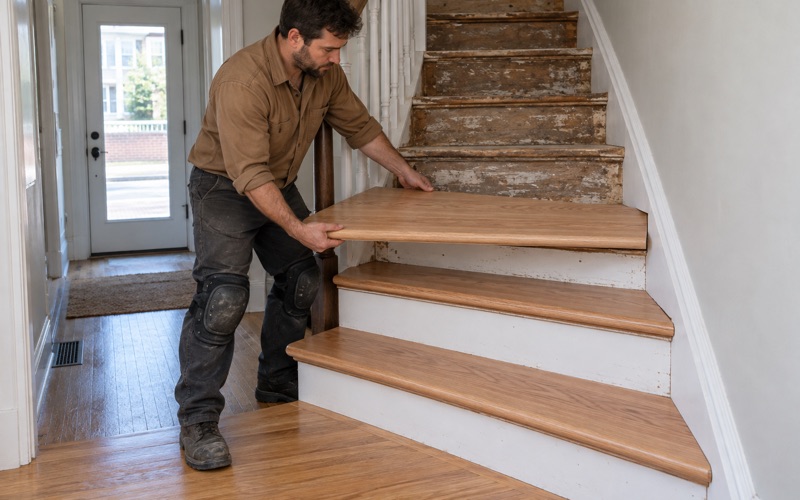
Stair treads and risers are quoted by the tread and the riser, never folded into a square-foot number for the floor they happen to land on. Nosings, reducers, thresholds and quarter round are counted the same way. On an engineered floor, we measure the wear layer before anyone promises it can be sanded, because some of them can take a full sand and some can take nothing but a recoat.
Repairs an Old Building Brings With It
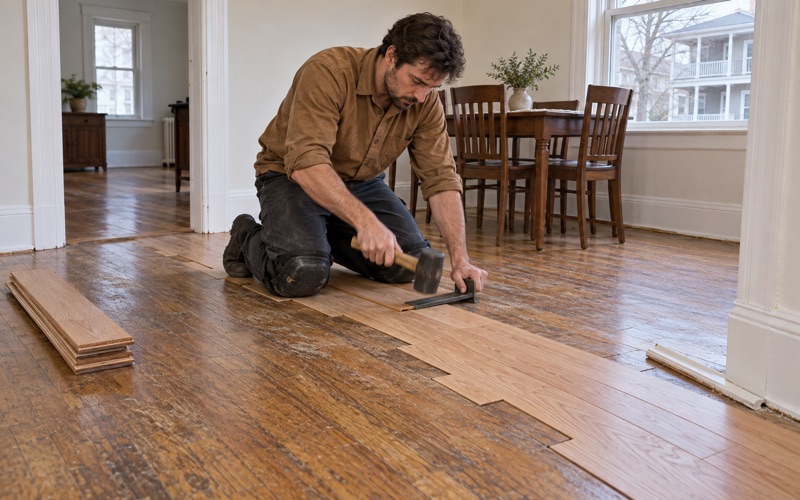
Where steam radiators and their risers have come out, the opening gets a weave-in patch in matching boards rather than a trowel of filler that will telegraph through the finish within a year. Hollow spots underfoot usually mean loose boards or a subfloor that has moved, and both are fixed before sanding rather than sanded over. Softness or fine holes in pine get looked at for powderpost beetle and carpenter ant damage, since neither is solved by a new coat.
What helps most when you call is the plain detail: the address, roughly when the building went up, which rooms are in scope, whether the floor is under carpet or exposed, and the date the unit has to be usable. Photographs of the worst stretch and of a spot where boards meet a threshold tell us more than a description can, and they are usually enough for us to say what the floor needs before we stand on it.
- 20+ Years on New England Floors
- Free Written Estimates
- Dustless Sanding