Revere Wood Flooring has been sanding, repairing and installing wood flooring in Hull for more than 20 years, and the houses on this peninsula ask for a particular kind of attention. Most of what we open up here is older than the finish sitting on top of it, and a good share of it has spent decades within a few hundred feet of open water. That combination decides the order we work in, long before anyone picks a sheen level.
Every estimate we write in town starts with two readings rather than a square-foot number: what the boards actually are, and what the moisture is doing. A floor that meters wet, or that has already been sanded three or four times, is a different job from the one a homeowner pictured when they called. We would rather say so at the doorway than halfway through a grit sequence.
What follows is how we handle red oak, old pine and engineered floors in Hull specifically: the prewar stock, the houses that sit empty part of the year, and the water that occasionally finds its way inside. None of it is exotic work, but the sequence matters, and getting it wrong on a coastal floor costs more than it does inland.
A 1915 Seawall and the Repair That Ran Through 2018

The Nantasket Beach seawall went up in 1915 and is owned and maintained by the Massachusetts Department of Conservation and Recreation. By the account of the federal project record it was relatively stable and well maintained from its construction onward, until roughly 25 years of erosion undermined its footing and produced several partial failures along the northern and southern sections. That is a long service life for a structure standing between a residential street grid and the Atlantic.
What the Army Corps project covered
DCR and the New England District of the US Army Corps of Engineers signed a Project Partnership Agreement in April 2016 for the Nantasket Beach Hurricane and Storm Damage Reduction Project. The phase that followed addressed 2,200 linear feet of seawall that had remained unprotected and, in the project’s own words, was still vulnerable to erosion and future undermining. Construction on that stretch ran from roughly the end of February 2018 to the end of May 2018, and an earlier Corps analysis, made after December 2003 storm damage, had already found a 2,000-linear-foot section unstable.
Why a floor crew keeps track of it
We are not coastal engineers, and we make no claim about which individual houses did or did not take water in any given year. What that history tells us is simpler and more useful: this is a town where the shoreline itself needed a named, dated federal repair, on a peninsula of about 2.8 square miles that is the smallest town by land area in Plymouth County. Water is a normal variable in a Hull floor job, not an emergency assumption.
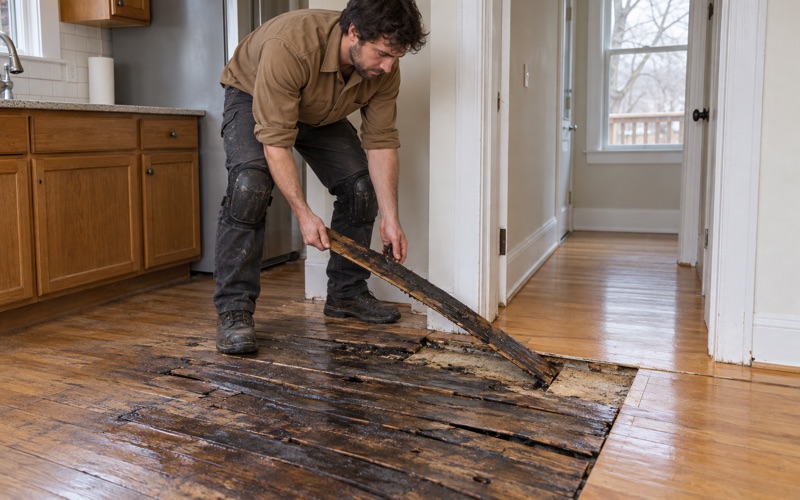
So when we are called to a wet floor here, we trace the water back to where it came in, whether that was storm, surge, or a burst pipe in a house nobody was staying in that week, and then dry and meter the structure before a single board is pulled. Rooms get photographed and measured for the adjuster while the floor is still wet, because that record is worth far more then than it is three weeks later. Pulling boards first destroys the evidence and usually the subfloor’s chance of drying evenly.
Looking for wood-flooring closer to Dorchester? See Wood-Flooring in Dorchester.
Prewar Boards Under Whatever Came Later
Hull’s housing stock is genuinely old. The 2024 five-year American Community Survey counts 2,550 of the town’s 5,838 units, or 43.7 percent, as built in 1939 or earlier. That share sets our expectations before we arrive: cut nails and face nailing, narrow old-growth pine in the back rooms, early red oak in the front ones, and a finish history nobody wrote down.
Reading what is left to sand
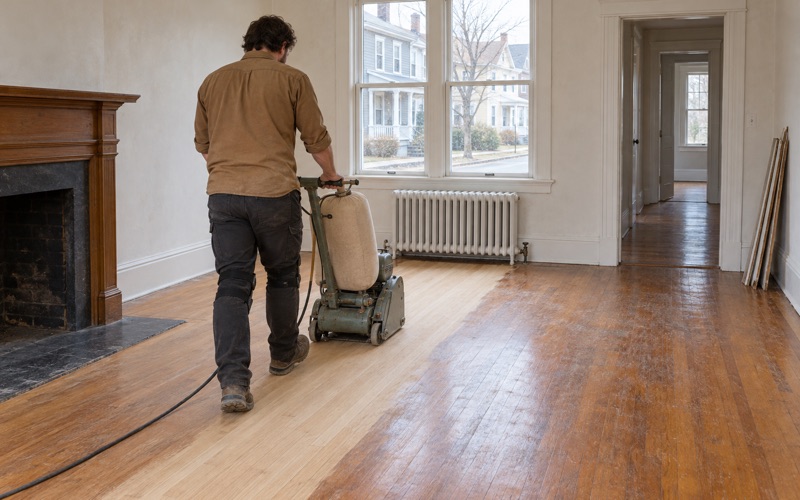
Old pine and early oak get checked for remaining thickness first. A floor sanded four times has very little left above the tongue, and running a drum sander across it buys a homeowner one good year and then a replacement. Where the wear layer is thin, a screen and recoat keeps the floor in service without spending what is left of it.
The same measurement applies to engineered floors, which turn up in newer construction and in remodeled lower levels around town. We measure the engineered wear layer before anyone promises it can be sanded, because the honest answer is often that it can be done once, carefully, and never again.
Under carpet, linoleum and paint
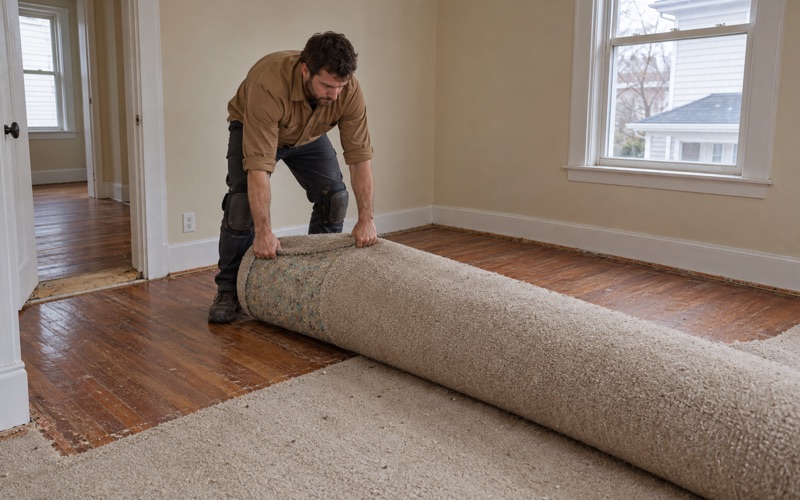
A surprising amount of original oak in Hull is still hidden under something. When we uncover it, the carpet pad, staples, tack strip and any linoleum or black mastic come off completely before a sander is switched on, because adhesive left in place loads the abrasive, burns, and prints straight through the new finish.
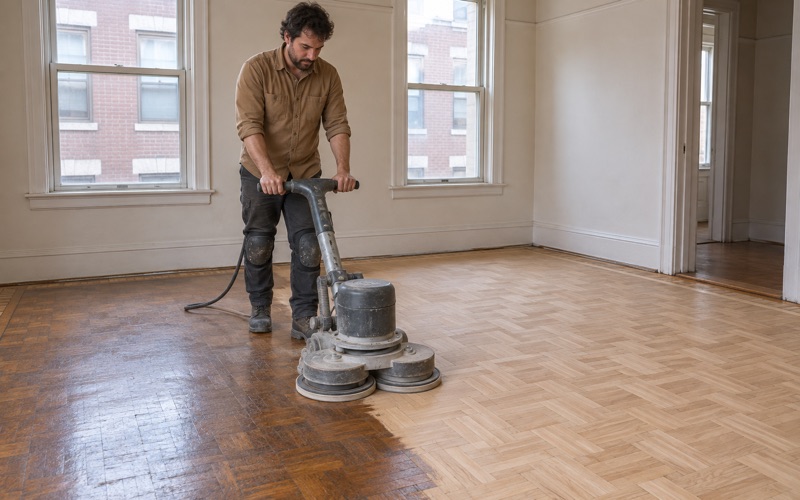
What we find underneath is usually red oak in strip, sometimes white oak in the better front rooms, and occasionally a parquet or a herringbone laid at a hallway or a stair landing. Patterned floors are sanded differently, in several directions with a lighter cut and more buffer time, and we price them that way from the start rather than discovering the problem on day two.
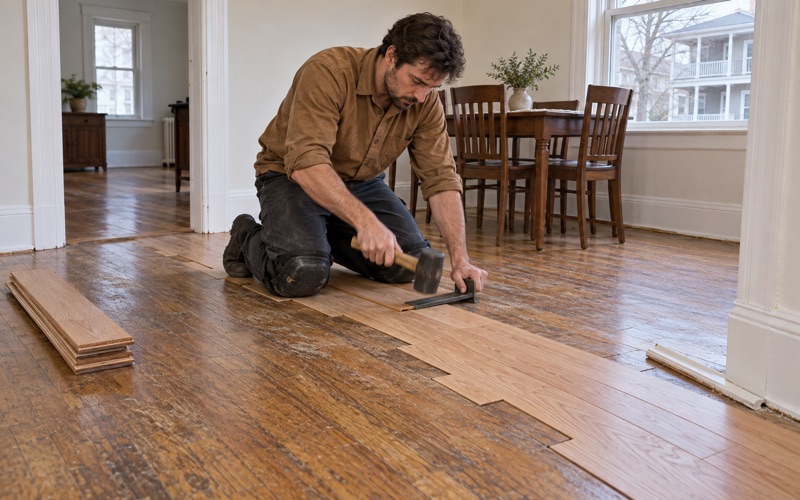
Paint is where the build year stops being trivia. Massachusetts runs its own lead-safe renovation rules on homes built before 1978, and with well over half of Hull’s units predating 1960, we read the build year and the painted surfaces, including baseboard, stair risers and thresholds, before any dust is made. Where old steam radiators and risers have been taken out, we weave in matching boards rather than filling the void, so the patch reads as floor instead of a scar.
Part-Year Houses and What the Air Does to Them
Hull has 750 housing units, 12.8 percent of the total, held for seasonal, recreational or occasional use. A floor in a house that is closed up for months behaves differently from one in a house heated and dehumidified year round, and most of the complaints we hear from part-year owners trace back to that rather than to a defect in the wood.
Cupping, gapping and the season that caused them
A closed house in August holds humid air with nothing running to remove it, and the boards take on moisture from below and at their edges, which is cupping. A house shut down through a cold snap with the heat set low runs the other way and opens winter gaps that close again by May. Crowning usually shows up when a cupped floor was sanded flat while it was still wet, which is exactly why we meter instead of eyeballing.
Scheduling around an empty house
We plan part-year work with that cycle rather than against it. Material is acclimated inside the house it will live in, expansion gaps are cut for the swing this particular building actually sees, and finish work is scheduled so the cure gets ventilation and a stable temperature instead of a locked front door. Where a floor has already buckled, the cause is fixed before the flooring is.
Finishes are chosen against the Massachusetts coating limits, which are tighter than the federal ones, so the waterborne polyurethane or hardwax oil we put down in Hull is picked for what is both durable and legal here. Just under 80 percent of the town’s occupied units are owner-occupied, so these decisions usually land on somebody who intends to live with the result for years. Vacant rentals are the exception, and we turn those around inside the window before the unit is signed off and re-let, because an empty week is the cheapest week to sand a floor.
Condominium buildings bring their own paperwork, and Hull has had them since the Paragon Park property was sold for condominium development after the park closed in 1984. Where the bylaws set a rug coverage rule or specify an underlayment, we book the job around those rules and the building’s own schedule rather than discovering them at the elevator.
Planning a Floor Project in Hull
Most projects here settle into the same sequence: look at the floor, meter it, agree on the scope, then schedule around weather and occupancy. The National Weather Service puts the town in forecast zone MAZ019, Eastern Plymouth, and we read that forecast before a delivery or a finish day, since humidity and a hard onshore wind both change how a coat lays down and how long it needs to cure.
How we quote it
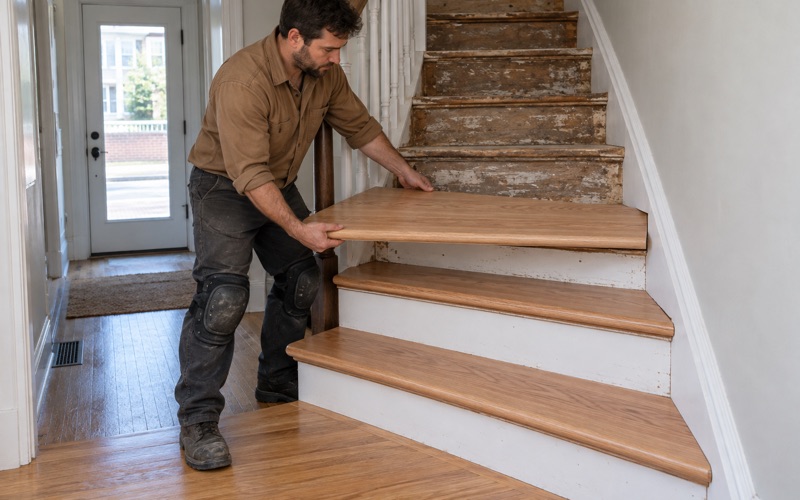
Stairs are quoted by the tread and the riser, never folded into a square-foot number. A staircase is slow hand work, and pretending otherwise is how a quote gets rewritten in the middle of a job. Weave-in repairs, board replacement and radiator removal patches are counted the same plain way, board by board.
Two-family houses are done one floor at a time, so whoever lives on the other floor stays in the house while the work runs. Sanding is dustless, with HEPA vacuum collection at the machine, which matters more in a small coastal house than in a large one.
Color, sheen and the finish schedule
Color is settled on site. We put stain samples down on your own sanded boards rather than on a showroom panel, because red oak, white oak and old pine each take a stain differently, and the light in a room facing open water is not the light in a showroom. Where a deeper color is wanted we water pop the floor first so the stain takes evenly, then agree on a sheen level before the first coat goes down.
Who else is involved
The Town of Hull Building Department sits at Town Hall, 253 Atlantic Avenue, and can be reached at (781) 925-1330. Applications are mailed or left in the drop box in front of the building, and a Building Inspector is usually available Monday through Thursday from 8 to 10 a.m. and 2 to 3 p.m. Hull is in Plymouth County and has been incorporated since 1644, so the record-keeping runs deep and that office is the right place to ask what a given project involves.
If your floor is wet, start there and with your insurer before anything is torn out, and call us while the damage is still measurable. If it is simply tired, orange under an old shellac finish, or gapped after a hard winter, tell us the build year and what is sitting on top of the boards, and we will tell you what the floor can still take.
- 20+ Years on New England Floors
- Free Written Estimates
- Dustless Sanding