
Revere Wood Flooring has been repairing hardwood floor water damage in Revere, MA for more than 20 years, serving surrounding cities including Chelsea, Nahant, Winthrop Town, Everett and Malden. A wet floor is not a flooring job until it is a drying job, and that order is the whole difference between a floor that recovers and a floor that gets torn out twice.
This is coastal, low-lying, densely built housing stock, and water reaches floors here in more ways than one. The Regional Saugus River Floodgate Project named Revere among the six communities it was meant to protect, alongside Lynn, Malden, Everett, Saugus and Nahant. Meanwhile 65.4 percent of the city’s 24,139 housing units predate 1980, which means aging supply lines, steam risers and shared plumbing stacks running through occupied floors.
So we start with two questions before anyone talks about boards: where did the water come in, and how far did it travel. Everything else — what can be dried, what has to be replaced, and what your adjuster needs to see — follows from the answers.
Where The Water Came From Decides Everything
Burst Pipes And Failed Supply Lines
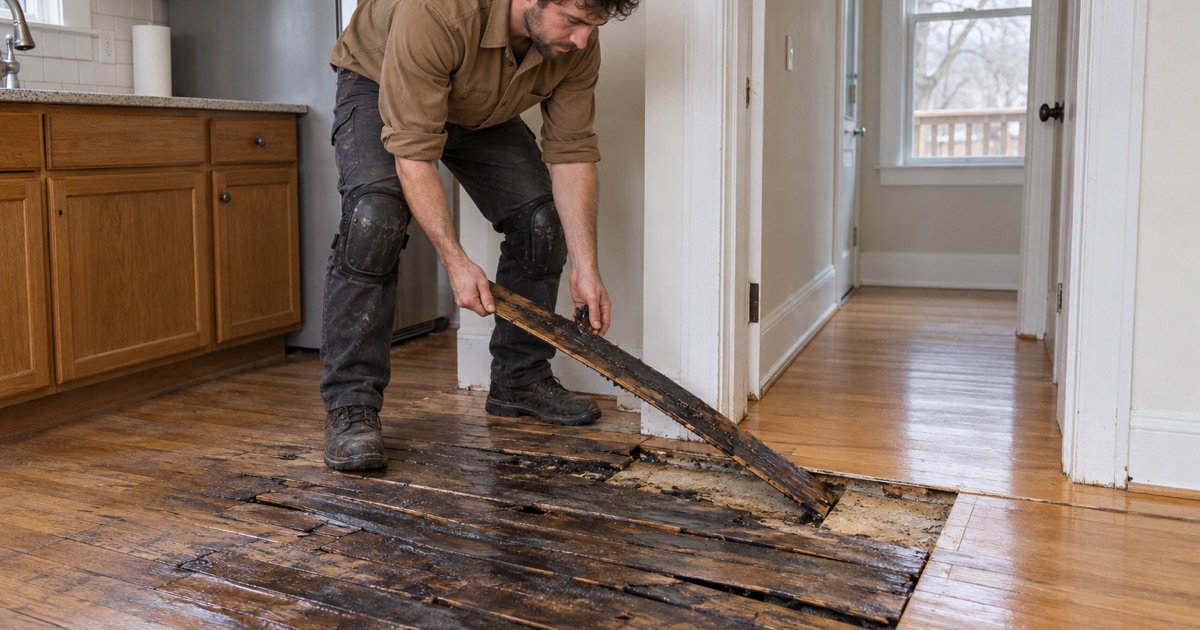
A supply line that let go under pressure puts clean water across a floor fast and often pushes it under boards well beyond the visible wet area. We trace the run, meter outward from the source until the readings return to normal, and map the real extent rather than the obvious one. In a stacked building that trace frequently crosses into the unit below, which changes who is involved and how the claim is written.
Appliance And Dishwasher Leaks
The slow leak under a dishwasher, refrigerator or washing machine is the most damaging kind, because it runs for months at a rate nobody notices. By the time the floor cups, the subfloor underneath has usually been wet far longer than the finish floor has. We open enough to see the actual condition of the substrate rather than pricing from the surface, since the visible damage is routinely the smaller half.
Storm Surge And Groundwater At Grade
Water that enters at grade or rises from below behaves differently from a pipe failure: it arrives dirty, it soaks the substrate from underneath, and it is treated differently by insurers. Lower levels and garden-level units are where this lands. We identify the entry path and document it plainly, because whether water came through a door or out of a riser is frequently the deciding fact on a claim.
What Water Does To A Wood Floor
Cupping While The Floor Is Still Wet
Cupping is the board edges rising above the center as the underside takes on more moisture than the top. It is a symptom, not a verdict, and a great many cupped floors flatten substantially once the assembly dries out evenly. The mistake that turns a recoverable floor into a replacement is treating the cup as permanent and cutting it flat while the wood is still holding water.
Crowning After A Premature Sanding
Crowning is what you get when a cupped floor is sanded flat before it has finished drying: the edges come off, the board later dries and shrinks, and the center is left standing proud. There is no fix for that except replacement, and it is entirely self-inflicted. We refuse to sand a floor until the readings say it has reached equilibrium, even when that answer is unwelcome.
Buckling, Delamination And Failed Adhesive
Standing water can push a floor clear of the subfloor entirely, particularly where expansion gaps were closed off at the perimeter. On engineered material it can delaminate the veneer from the core, and on glue-down and parquet it releases the adhesive bond. Each of those is assessed separately, because a buckled solid floor and a delaminated engineered one have very different chances of being saved.
Drying And Metering Before Any Boards Come Up
Moisture Mapping Through Boards And Subfloor
We take readings in a grid across the affected rooms and into the subfloor, not at one convenient spot, and repeat them over time so the trend is visible. A single reading tells you the floor is wet; a series tells you whether it is drying, how fast, and where the water is still sitting. That map is what decides the scope and what an adjuster can rely on.
Controlled Drying And Equilibrium
The goal is equilibrium with the room the floor lives in, not merely a dry surface. We manage the drying of the floor assembly and coordinate with a restoration contractor where equipment or containment beyond our scope is needed. Drying too aggressively is its own hazard, because wood driven down too fast checks and splits along the grain.
Deciding What Is Salvageable
Once readings are stable we decide board by board what stays. Boards that flattened, held their fastening and kept their finish integrity stay; boards that split, delaminated or stayed cupped come out. That decision cannot honestly be made in week one, which is why anyone quoting a full tear-out on the day of the loss is quoting a schedule rather than a floor.
Documenting The Loss For An Adjuster
Photographs And Readings While The Floor Is Wet
The evidence with the shortest life is the wet floor itself. We photograph the affected area with the water still present, record meter readings with dates, and measure the rooms before anything is disturbed. A week later that record cannot be recreated, and a claim argued from memory is a claim decided against the homeowner far more often than not.
Measured Scope Separating Drying From Flooring
Our written scope separates the drying and monitoring from the board replacement, the subfloor work and the refinishing, with quantities against each. Adjusters work from line items, and a single lump figure for a floor invites a lower one back. Giving them something readable is not advocacy — it is just the difference between a file that moves and one that stalls.
What We Do Not Do On A Claim
We do not adjust claims, negotiate with carriers, or tell you what your policy covers. We are not public adjusters and we do not pretend to be. What we provide is a measured, dated, photographic record and a scope of repair, and we will talk your adjuster through any technical question about the floor itself.
After The Floor Is Dry
Board Replacement And Subfloor Repair
Boards that did not recover come out and matching stock is woven into the existing runs. Where the subfloor delaminated or lost strength it is replaced first, because laying new flooring over a compromised substrate reproduces the failure as squeaks and deflection within a year. Species, cut, grade and thickness are matched to the original floor, not to what is available quickly.
Refinishing The Room As One Floor
Repaired areas are sanded and finished together with the surrounding room, so new and old wood take the same stain and the same number of coats. Finishing a patch on its own guarantees it stays visible. We hand over the walk-on, furniture and rug dates exactly as on any refinishing job.
Keeping It From Happening Again
Where the cause was preventable we say so on the way out: a supply line worth replacing, an appliance pan worth fitting, a sump pump that did not keep up, an expansion gap that was closed off and should not have been. It costs nothing to mention and it is the part of the visit clients tell us they remember.
- 20+ Years on New England Floors
- Free Written Estimates
- Dustless Sanding