Revere Wood Flooring has spent more than twenty years on wood flooring in Everett, and most of what we do in the city is repair-led rather than wall-to-wall replacement. A landing that has lost boards, a kitchen threshold worn through to bare wood, a bedroom floor cupped after a pipe let go upstairs — those are the calls we get. We quote the fix in front of us, and we say plainly when a full refinish is the cheaper end of it.
Most of that work happens in buildings nobody moves out of, which changes the sequence far more than it changes the technique. We stage a two-family one floor at a time so the household above or below stays in the house, and we set the days around who has to be out the door in the morning.
A fair share of it also starts with paperwork rather than a worn floor. An owner who has heard from the city, or expects to, wants the work scoped, priced and finished on a calendar they control. That is a different conversation from a discretionary remodel, and it is the one this page is written for.
Floor Repairs Before an Everett Code Citation Becomes a City Bill
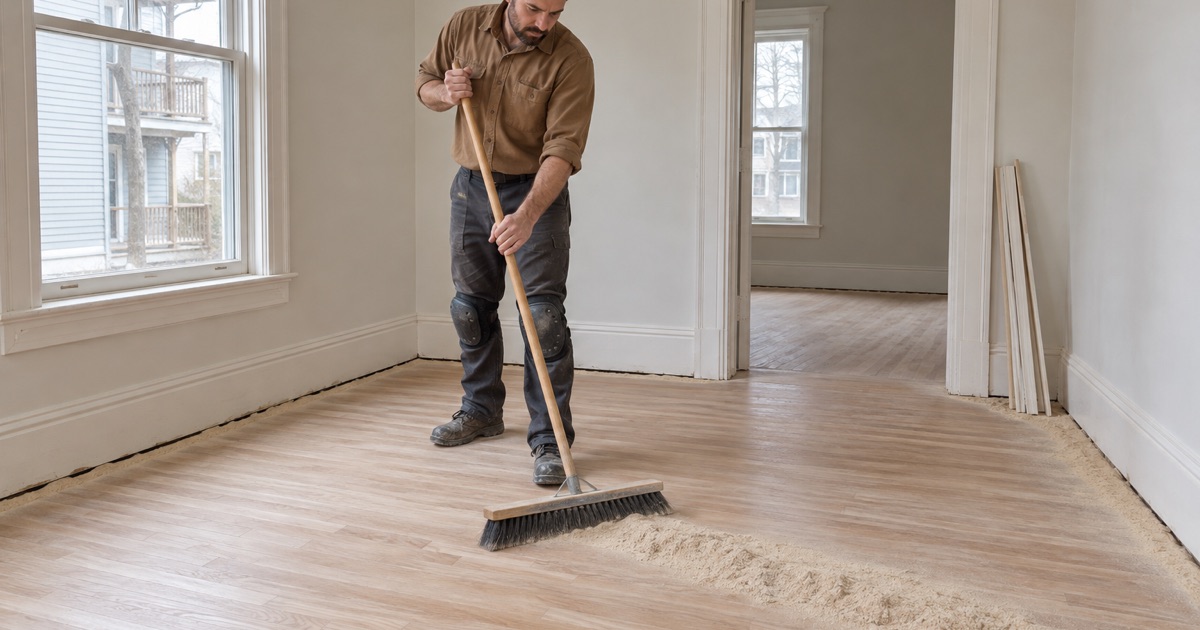
Everett coordinates code enforcement through a Code Enforcement Task Force, created by ordinance in 2004 and amended since. It is chaired by a mayoral appointee and seats the Police and Fire chiefs, the City Clerk, the City Solicitor, the Building Inspector, the director of the Board of Health, the chairman of the Licensing Board, the director of City Services and the City Council president. The point of putting all of those offices at one table is that a complaint about a building does not get handed around between departments.
What abating a violation is defined to cover
The ordinance defines abating a violation as returning the property to the condition it was in beforehand, and says that may include rehabilitation, demolition, removal, replacement or repair. Nothing in the chapter singles out flooring, and we do not pretend otherwise — a deteriorated floor reaches the city through the habitability and sanitary code language the chapter incorporates, not through any line about wood floors. What the definition does establish is that repair is one of the accepted ways out.
Why owners call before the deadline runs
If an ordered abatement is not completed, a director may undertake the work and charge the reasonable cost of it back to the owner, and the city may recover what is owed through a lien, by withholding permits, or through a collection agency. That is the practical argument for moving first: the work happens either way, but an owner who arranges it picks the contractor, the sequence and the finish. Each day a violation continues also counts as a separate offense, so a slow start is not a free one.
The ordinance also sets response-time guidelines that run from twenty-four hours where the risk is high, such as a condition threatening immediate harm or a repeat violation, out to two to four weeks for an isolated, non-emergent one. An owner reading a letter usually knows which end of that range they are on, and that is the number the schedule has to be built around rather than the other way around.
We work the way that timeline needs. Scope and price at the start, a written order of what happens in which room on which day, and photographs of the finished floor an owner can hand back to whoever asked about it. Where a full refinish will not fit the window, we say which part of the work closes the condition and which part can follow in a second visit.
Looking for wood-flooring closer to Malden? See Wood-Flooring Services in Malden.
Two- and Three-Family Floors Under Code Enforcement
Everett’s housing stock is built for enforcement at this scale: 52.5 percent of the city’s 18,827 units sit in two-to-four-unit buildings, and 62.8 percent of households rent. A flagged condition in one of those buildings is rarely a whole-building job. It is one unit, one stair hall, one back landing, with the rest of the address occupied the entire time.
Keeping a building livable while the floor comes up
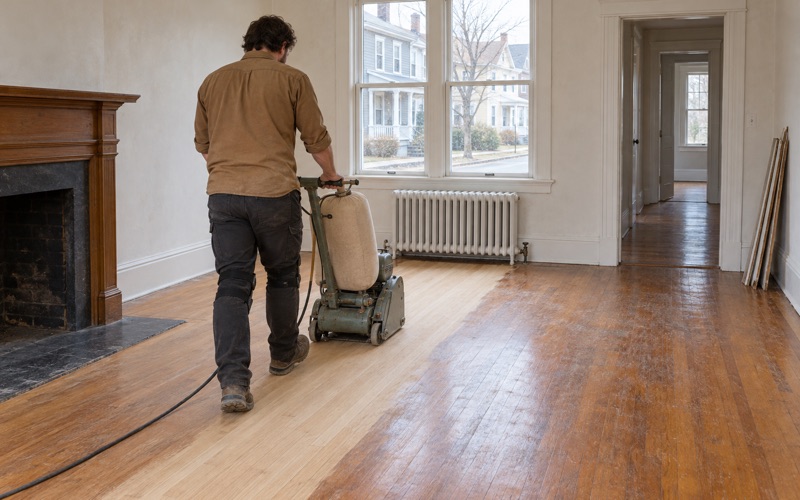
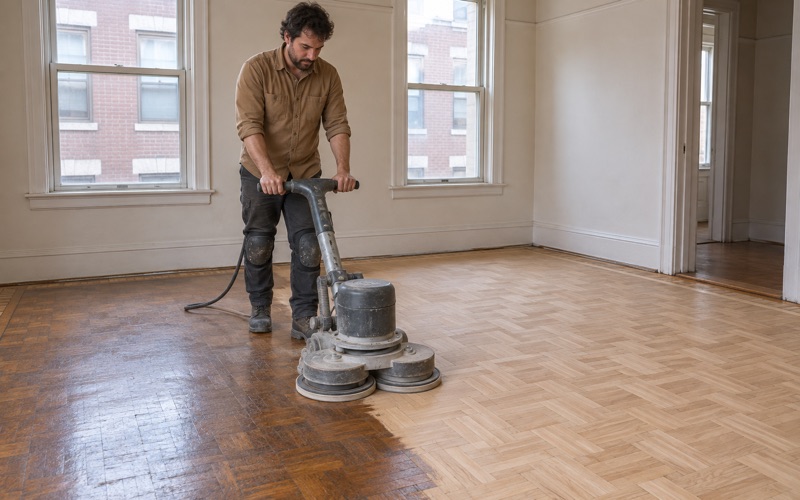
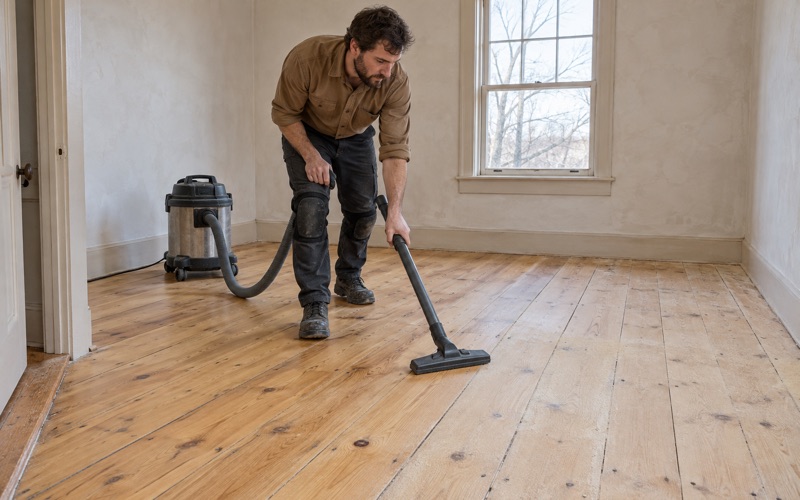
Our usual plan in a two-family is one floor at a time, with the stair hall sequenced so the other unit never loses its way in and out. Dustless sanding with a HEPA vacuum on the drum sander and the edger keeps the rest of the building usable, and containment at the unit door matters more here than in a detached house, because the neighbors are a few feet away rather than a yard away.
Repairs that read as repairs, not patches
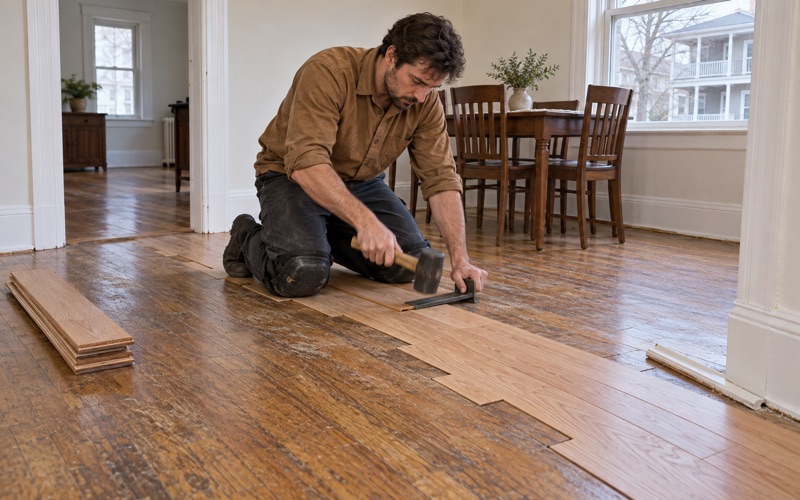
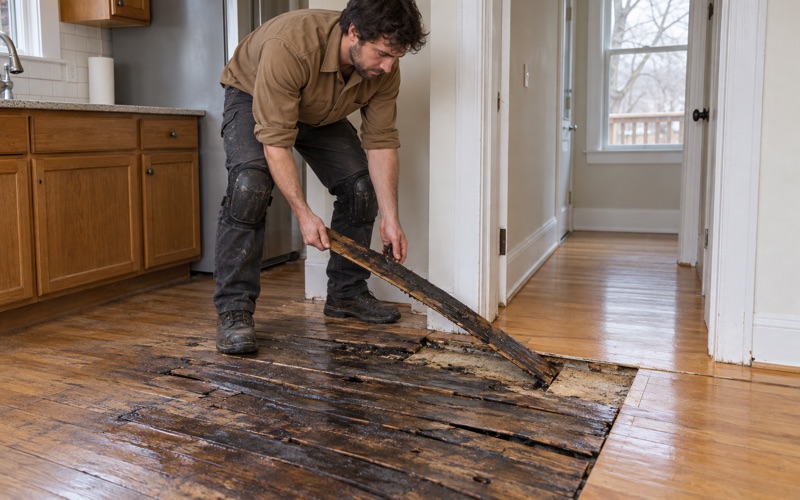
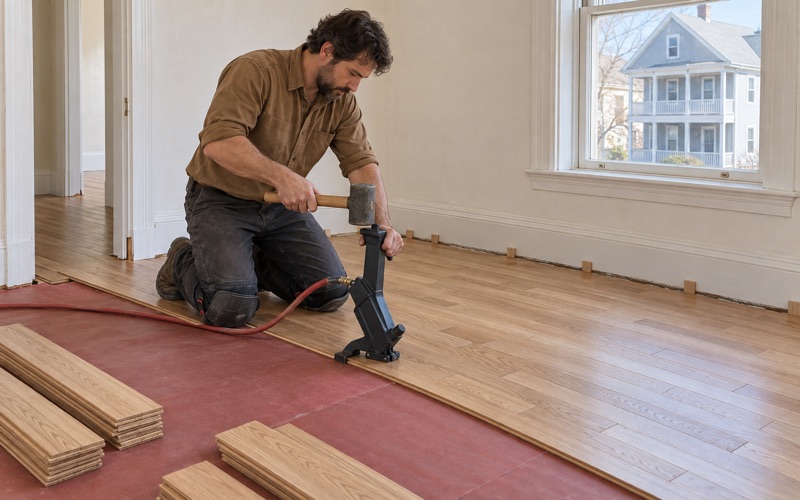
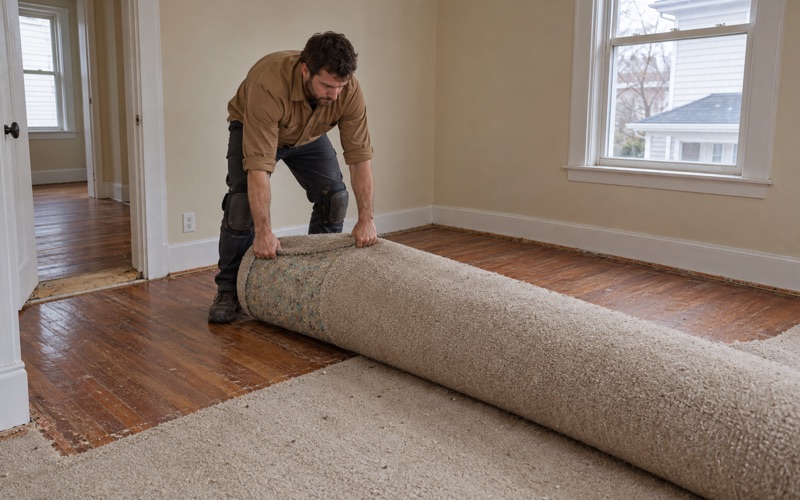
Most of what gets flagged in these buildings is local rather than general: hollow spots where boards have come loose from the subfloor, board gapping that has opened well past its seasonal range, a soft stretch around a riser, water stains and cupping under a kitchen sink. We weave in replacement boards in matching stock and set them to the surrounding grain and thickness instead of filling them. Where an old steam radiator has come out, the patch goes back as boards, not as a square of compound under a rug.
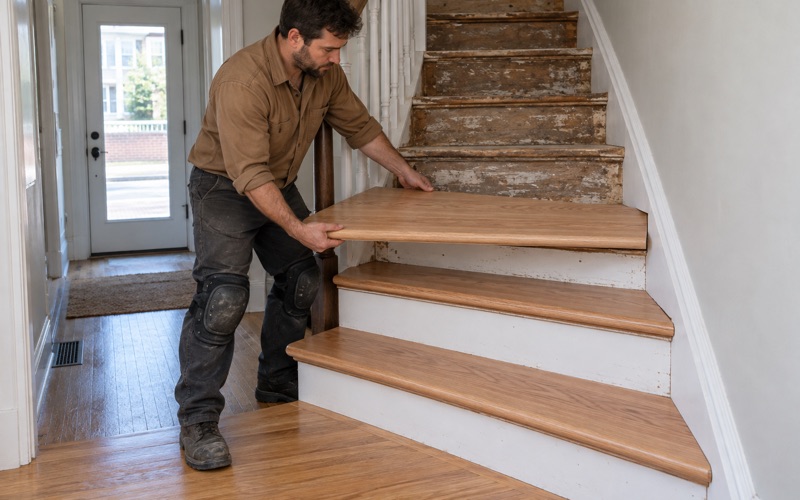
The shared parts of the building take more traffic than any room inside a unit, so they wear differently and they fail first. A front hall floor and the treads off it carry two households every day, and the back landing takes the weather through a door that does not always seal. We quote those surfaces separately from the unit work, because their condition is what a visitor sees before anyone opens an apartment door.
A vacant unit gets a tighter plan than an occupied one — short window, stages back to back, floor left ready for the people moving in. The sanding is identical; the scheduling is not.
Older Floors in Everett’s Prewar Two-Families
53.3 percent of Everett’s housing units were built in 1939 or earlier, which makes the prewar two-family and three-family the default floor we meet here. Under the carpet is usually a site-finished strip floor: red oak in the front rooms, eastern white pine or an early oak through the back rooms, bedrooms and halls, face-nailed with cut nails on the oldest of them.
How much floor is actually left
The first thing we check on a floor of that age is remaining thickness, because one sanded three or four times across ninety years has very little left above the tongue. We lift a threshold or a floor register and measure before quoting a full sand. If the answer is that it will not take another pass, we say so and price a screen and recoat, or board replacement through the worn traffic lanes, rather than selling a sanding that ends in exposed nail heads.
Old finishes, old paint, old damage
Orange oak under a shellac finish, black mastic left behind by linoleum, and tack strip, staples and carpet pad make up the usual removal list before any grit sequence begins. On a house of this vintage we also read the build year and the painted surfaces before the sander is switched on, because Massachusetts runs its own lead-safe renovation rules on housing built before 1978, and that changes how baseboard, stair risers and door casings are handled.
Insect damage turns up in the older back rooms as well: powderpost beetle exit holes in pine, carpenter ant galleries where a sill stayed wet through too many winters. Those sections come out and go back as new boards, because sanding over them only buys a season.
What an old floor looks like once it is done
We tell owners what to expect before the first grit goes down, because a ninety-year-old floor does not come back looking new. Old-growth pine keeps its nail lines and its knots, and a parquet or herringbone panel in a front room is repaired panel by panel rather than rebuilt. Patched areas of red oak read slightly differently from the boards around them until the finish has had time to settle.
Seasonal movement stays visible too. A floor that has spent decades on steam heat opens and closes at the seams every year, and filling those seams tight in February only guarantees they split somewhere else in August. We set expectations at the quote rather than at the walkthrough, so nobody is surprised by a floor behaving the way its age says it will.
Planning a Floor Repair in Everett
Everett’s Inspectional Services Department sits at City Hall, 484 Broadway, and its stated responsibilities include residential and commercial habitability of dwelling units. For an owner, that is the office a floor’s condition is weighed against, which is a good reason to know what is being asked before the scope is written.
Moisture first, finish second
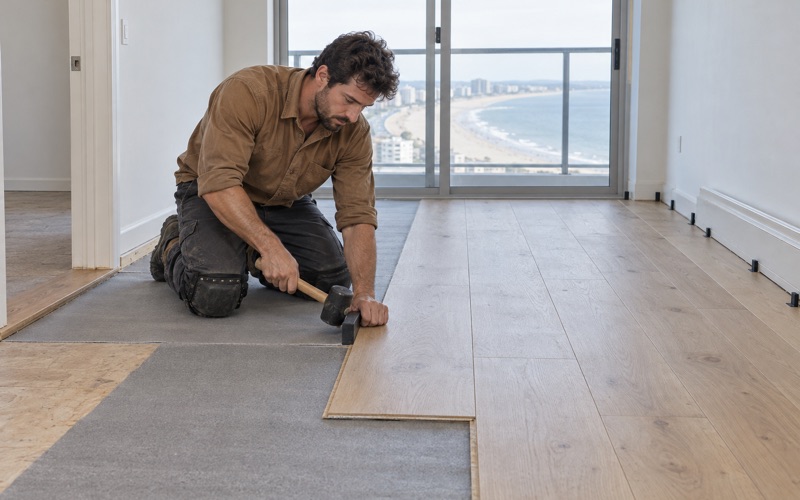
We meter the subfloor and the boards before anything is laid or sanded, and we trace water back to where it entered — a burst supply line, a failed roof above a top-floor unit — before pulling a single board. New material acclimates inside the unit it is going into, with the expansion gap held at the walls, because a floor laid at the wrong moisture content comes back as cupping or crowning in the first heating season. In a building on steam heat, winter gaps are ordinary movement; a floor that buckles is not.
When the damage came from a burst pipe or a storm, we photograph and measure the affected rooms while the floor is still wet, and we keep the meter readings from the drying. An owner carrying a code deadline and an insurance claim at the same time needs both records to say the same thing, and they are easier to gather on the first visit than to reconstruct after the boards are up.
Finish choices and what they cost in downtime
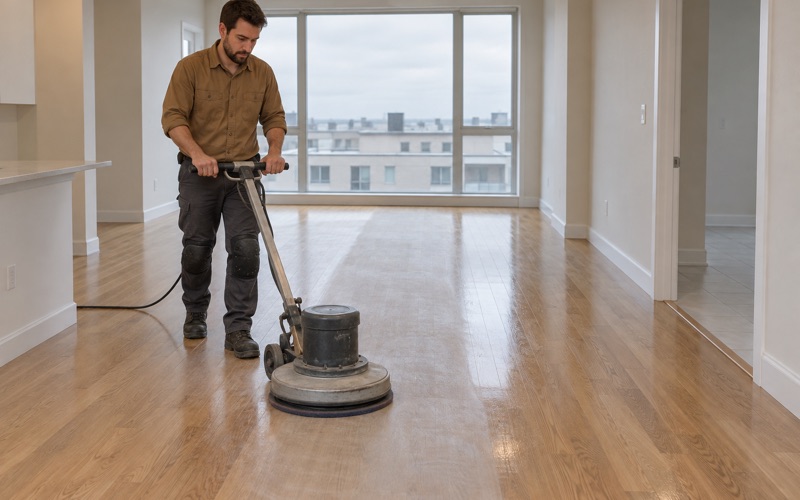
We pick finishes against the Massachusetts coating limits, which are tighter than the federal ones. In an occupied two-family that usually points to a waterborne polyurethane, which returns a unit to use sooner than an oil-modified schedule, while hardwax oil suits an owner who wants a repairable surface and a lower sheen level. Stain samples go down on the customer’s own floor, in that room’s own light, before anything is committed to.
Stairs are quoted by the tread and the riser, never folded into a square-foot number, and an engineered floor has its wear layer measured before anyone promises it can be sanded. A scope written honestly at the start is what keeps a repair with a deadline attached to it from turning into a second visit.
- 20+ Years on New England Floors
- Free Written Estimates
- Dustless Sanding