Revere Wood Flooring has spent more than 20 years on wood flooring in Chelsea, and a large share of what we do in this city is tied to a unit changing hands rather than to a floor wearing out. The boards are the same boards they were under the last tenancy. The person standing on them is not.
That is the practical difference between a rental turn and a conversion. A turn asks whether a floor is good enough for the next lease. A conversion asks whether it is good enough for somebody who is about to own it, pay a mortgage against it, and live with it for years. Worn traffic lanes, a dull hallway and a gapped board clear the first test and fail the second.
So we work these units one at a time, on a schedule we did not set, in buildings that are usually still partly occupied. Most of the job is fitting careful work into a short, borrowed window.
Floors When a Rental Building Converts to Owned Units

Massachusetts condominium law lets a city or town adopt a conversion ordinance that goes further than the statewide default, and Chelsea has done exactly that. The city’s Code of Ordinances carries a condominium and cooperative conversion section, cited as Chapter 6, requiring an owner to notify the city before and during a building’s conversion notification process, with penalties attached for an owner who fails to give that notice.
That is the owner’s obligation and their attorney’s, not ours, and nothing we have read says it reaches interior condition, finishes or floors at all. What it does is set a pace. The units come free one at a time instead of all at once, each one has a date attached to it, and the floor work has to land inside that date.
A City Where Three Households in Four Rent
Chelsea rents by a wide margin. Of 13,716 occupied housing units, 10,148 are renter-occupied and 3,568 are owner-occupied, which is 74.0 percent against 26.0 percent. Most of the housing here has spent its life under a landlord’s maintenance standard rather than an owner-occupant’s.
A conversion is where those two standards meet in one room. Nothing about the floor changed overnight. The buyer reading it simply has a different set of questions, and they are asking them while standing in an empty apartment with good light and nothing to look at but the floor.
Working to Somebody Else’s Calendar
We would rather hear about a unit early than perfectly. If an owner can tell us which apartment is coming free, roughly when, and when the first showing is likely to be, we can size the work against that window honestly and say so if it does not fit. A half-sanded unit is worse than an untouched one, because it can be neither shown nor lived in.
Access is the other half of it. Each unit is a separate job with its own key, its own walk-through and its own sign-off, and in a building mid-conversion there is rarely one person on site all day to open doors. We plan around that up front, because a crew standing in a hallway waiting for a key is the fastest way to lose a day out of a short window.
Looking for wood-flooring closer to Nahant? See Wood-Flooring Services in Nahant.
One Unit at a Time in a Converting Three-Family
Three- and four-unit buildings are Chelsea’s largest housing type. Of 14,165 housing units in the city, 3,871 sit in buildings of three or four units, which is 27.3 percent of the stock and more than any other size class, and 3,217 of those are rented. A building like that does not convert as a project. It converts as two or three separate apartments sharing one front stair.
Each unit is also its own decision. Once the building converts, the apartments are owned separately, so nothing says the second floor has to match the third in species, stain or sheen. We still tell owners when two units in one building are close enough that matching them is cheap, and when chasing a match across floors means sanding a floor that did not need it.
Keeping the Other Floors Livable
We do these one floor at a time, so whoever is still in the house stays in the house. The common stair is treated as a corridor rather than a work zone: treads papered and protected, the unit doorway sealed, and the sanding run dustless with HEPA extraction at the machine instead of a cleanup in the hallway afterward.
Noise and access get the same treatment. Machine work is grouped into the hours that suit the building, and material comes up the stairs in one planned trip rather than in pieces all day.
Reading the Unit Before the Sander Comes Out
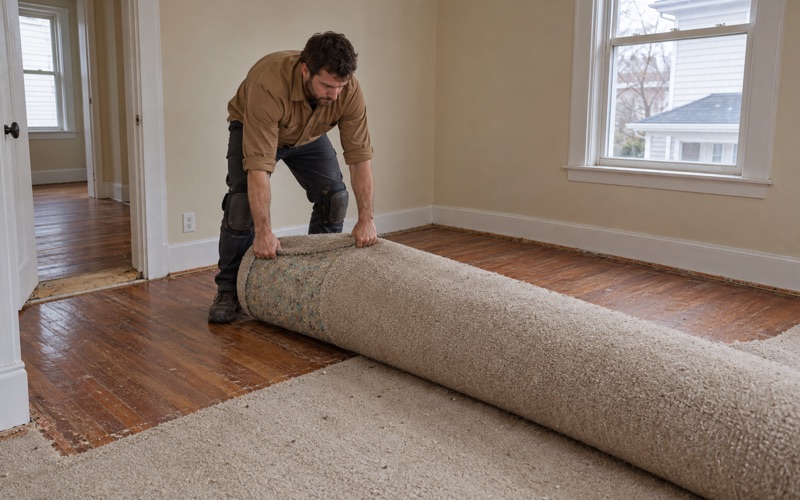
An empty apartment in an old three-family is rarely a clean slate. We pull carpet, pad, tack strip and staples, lift linoleum and whatever adhesive sits under it, and find out what the subfloor and the finish floor actually are before anyone quotes a sand. Black mastic under old tile changes the job; so does a floor that turns out to be a thin overlay rather than the original.
Under a great deal of Chelsea carpet there is red oak strip flooring in good condition. On the older floors it is often eastern white pine, and now and then a parquet field in a front room that has never been touched.
The Vacancy Is the Whole Window
We are used to turning a vacant unit around inside the gap before it is signed off and re-let, and a conversion uses that same discipline for a different ending. The unit is empty, the clock is short, and the next person through the door is a buyer instead of a tenant.
Refinishing Before a Converted Unit Goes On the Market
How Much Floor Is Actually Left
The first question on an old floor is not the color, it is remaining thickness. A strip floor sanded three or four times across a century has very little wood left above the tongue, and one more pass with a drum sander can take what is left. We measure first and say what we find. The same applies to an engineered floor from an earlier renovation, where the wear layer decides whether it can be sanded at all; a thin one gets a screen and recoat or it gets left alone.
On a pine floor the arithmetic is different again. Old-growth pine is soft enough that it sands fast and forgives less, and on a board that has already lost most of its face we would rather do less and keep the floor than take it to bare wood and find a cut nail head sitting proud.
Sanding, Stain and Sheen
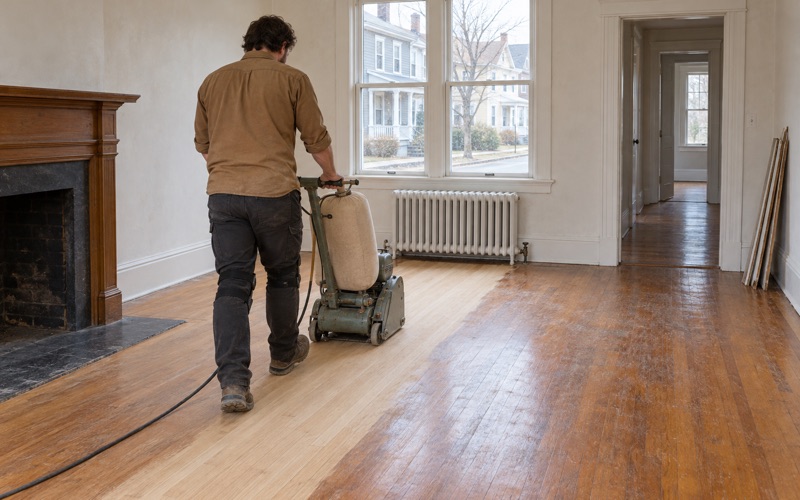
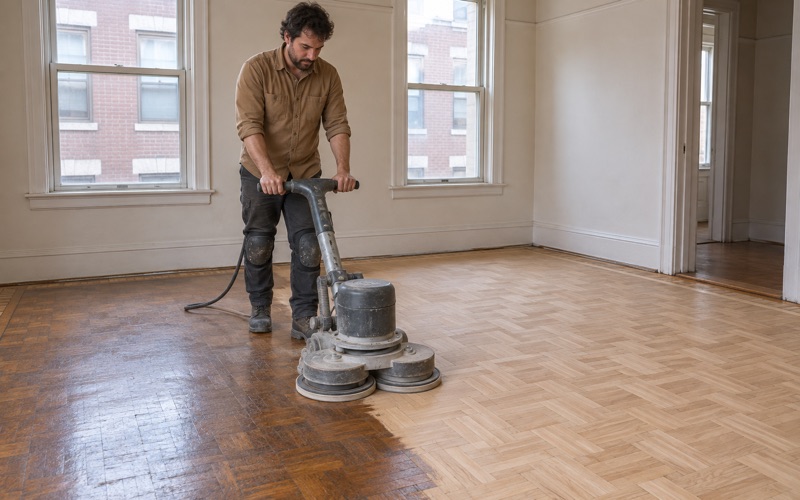
Where there is thickness to work with, it is an ordinary grit sequence, drum or orbital depending on the floor, then a buffer before finish. An old shellac finish and a century of amber come off with it, which surprises people who have only ever seen their red oak looking orange. If a stain color is going down, we put samples on the floor itself and look at them in that unit’s own light, and we water pop when a darker color needs to take evenly across the field.
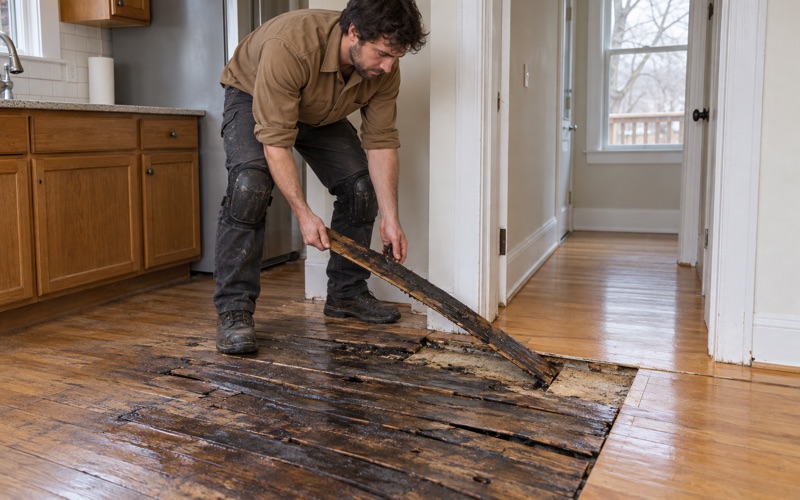
Some marks do not sand out, and it is better to hear that before the machines arrive than after. Pet urine stains reach through the board and into the subfloor, and deep water stains often do the same. Those boards get replaced and woven in, or the floor gets a color dark enough to carry them, and which of the two makes sense is a conversation about budget and listing date.
Finish, Cure Time and the Showing Date
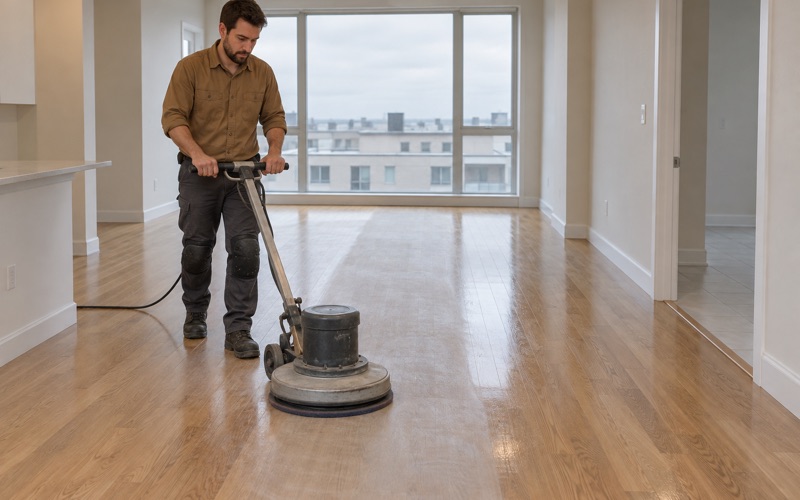
Finish is a scheduling decision as much as a taste one. Massachusetts holds coatings to limits tighter than the federal ones, so the waterborne polyurethanes and hardwax oils we use are picked against the state’s numbers. Waterborne also buys days back: an oil-modified polyurethane keeps a unit out of service longer than most conversion calendars allow. Cure time, not dry time, is what decides when furniture, rugs and a photographer can come back in.
Where a unit has no floor worth saving, a prefinished installation skips the finish cure entirely and the floor is walkable the day it goes down. A site-finished floor gives a flatter surface with no micro-bevel between boards, so the choice usually comes down to how many days the unit has.
Older Floors Under a New Condominium Association
Half of Chelsea’s housing predates the Second World War, with 49.6 percent of units built in 1939 or earlier. Those are the floors most conversions inherit: old-growth pine and early oak, face-nailed with cut nails, carrying a century of radiators, risers and moved partitions cut through them.
Patches Woven In, Not Filled
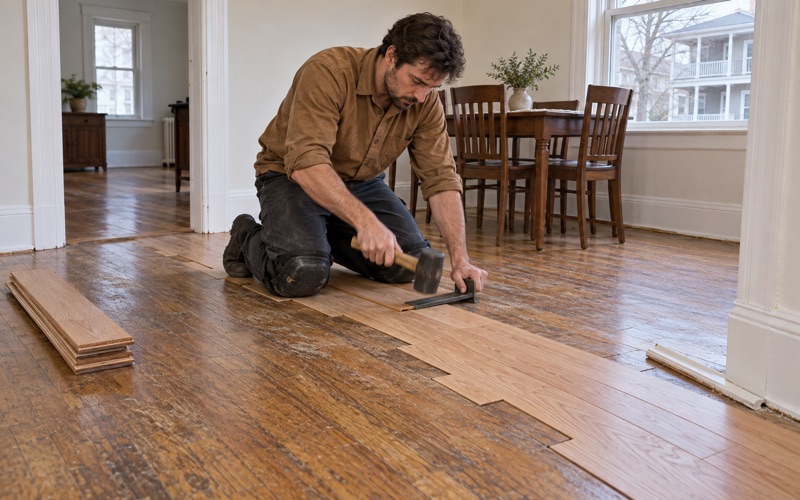
Where a steam radiator came out or a riser was abandoned, there is a hole in the middle of the field. We weave in matching boards rather than fill it. A weave-in repair disappears into the run of the grain; a filled one announces itself the moment the light goes low and somebody looks down the length of the room, which in an empty unit for sale is most of the time.
Hollow spots, loose boards and a stair run worn through at the nosing get the same attention before finish goes down, because they are exactly what a buyer’s inspection walks the unit listening for.
Build Year Before the Machine
We read build year and painted surfaces before a sander is switched on. Massachusetts runs its own lead-safe renovation rules on homes built before 1978, and in a city with this much older stock the question comes up on nearly every converting building. It matters most where paint and abrasives meet: painted floors, stair parts and trim.
Bylaws, Rug Coverage and Timing
A converted building comes with condominium bylaws, and those often carry a rug coverage rule and an underlayment requirement over an occupied unit below. We would rather read them before the job than hear about them afterward. In the bigger buildings, and 23.6 percent of Chelsea’s renter households live in buildings of fifty units or more, there is usually a freight elevator schedule and a loading dock window to book around as well.
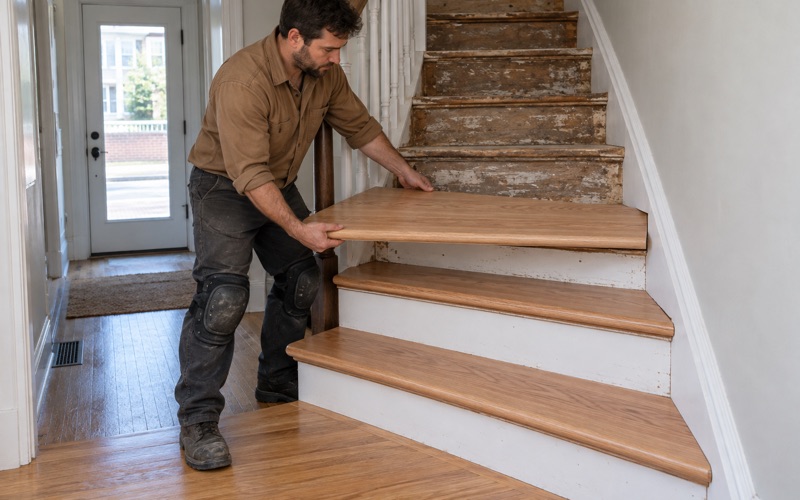
The common stair is its own question once a building converts. The treads and risers between the units usually stop being any one owner’s alone, and a stair run is hand work either way, so we quote it by the tread and the riser rather than folding it into the square-foot number for a unit.
Season belongs in the same conversation. Winter gaps open through the heating season and close again in summer humidity, so we take moisture readings on the wood and the subfloor rather than assume a unit acclimated while it sat empty. A floor laid tight in a cold, vacant apartment in February is the one that tells on itself in July.
- 20+ Years on New England Floors
- Free Written Estimates
- Dustless Sanding