Revere Wood Flooring has spent more than 20 years refinishing, repairing and installing wood flooring in Amesbury, and the jobs that fill our calendar here are almost never bare-subfloor new builds. They are floors that have already been walked on for decades, covered at least once, patched at least once, and sanded by somebody before us.
That history changes the first hour of a job far more than it changes the last. We measure how much wood is left in a board before anyone promises a full sanding, read the build year and the painted surfaces in the room before a machine is switched on, and quote stairs by the tread and the riser rather than folding them into a square-foot rate.
It also raises a question early in most conversations here: does the age of the house put a review board between a homeowner and a sanded floor? For the rules that actually exist in this city, it does not, and the sections below name those rules and show exactly where each one stops.
Amesbury’s Two-Year Rule for Older Buildings
Amesbury has no local historic district. What the city has instead is the Amesbury Historical Commission, whose stated purpose is to preserve and protect significant buildings and structures in the city, and whose primary responsibility is reviewing demolition applications. Those applications run through Chapter 225, Buildings, Demolition of, which began as Article 40 of the 1990 bylaws.
The chapter’s enforcement is blunt and citywide. No building permit may issue for two years on premises where a building carried on Amesbury’s Comprehensive Historic Resource Inventory, or a building 75 years or older, was voluntarily demolished other than under a demolition permit granted after complying with the chapter. Demolition applications go to the Office of Community and Economic Development at 39 South Hunt Road, and through the city’s OpenGov portal.
The Age Line Reaches Most of the Housing Stock
That 75-year threshold is not an edge case in Amesbury. Of the city’s 7,923 housing units, 2,825 were built in 1939 or earlier, which is 35.7 percent of everything standing, and 43.2 percent of the stock predates 1960. A very large share of the houses we are asked to look at sit on the protected side of that line.
What the number means for our work is not paperwork but wear history. A house that old has usually had its floors sanded more than once, has had partitions moved, and has had heating hardware installed and later pulled out, and each of those leaves something in the wood we have to plan around.
Where the Chapter Stops
Chapter 225 governs buildings coming down. It says nothing about what happens inside a building left standing, and refinishing, patching or replacing boards in an intact house is not demolition. No commission reviews a sanding schedule, and no inventory listing changes what grit sequence a floor needs.
We say that plainly because the confusion is common and it costs people weeks. Homeowners here sometimes delay a floor for a season believing an approval is pending somewhere, when the only approvals that matter are the ones inside the household.
Looking for wood-flooring closer to Chelsea? See Wood-Flooring in Chelsea.
Floors Inside the Mills Village Blocks
Amesbury does have mapped old fabric, just not the kind that regulates interiors. The Amesbury and Salisbury Mills Village Historic District, roughly bounded by Boardman, Water, Main and Pond Streets around Market Square, was listed on the National Register on May 16, 1985, under reference 85001121, and the area was the site of significant industrial development between 1800 and 1875.
The district includes Salisbury Mill #4, a four-story brick Greek Revival building, and the streets around it hold the densest concentration of mill-era construction in the city. Floors inside that footprint tend to be the oldest ones we are called to, and the oldest floors are the ones where a thickness reading changes the recommendation.
Age also brings questions a homeowner cannot see from standing height. On the oldest floors we check the board edges and the framing they sit on for powderpost beetle galleries and for carpenter ant damage, because either one turns a cosmetic refinish into a structural conversation. Finding it before the estimate is agreed is far cheaper than finding it on the second day of sanding.
A Register Listing Is a Record, Not a Rulebook
National Register listing documents significance. It does not create a local commission, it does not review interior work, and it does not add a step to a floor job inside the mapped blocks. A homeowner on Pond Street and one two miles out of the district get the same answer from us about scheduling.
The practical difference between those two addresses is the wood, not the regulation. Inside the district we expect early fastening, boards that have lost thickness to previous sandings, and subfloor movement that has to be addressed before finish goes down.
Rocky Hill and What a Preserved Interior Proves
The Rocky Hill Meeting House, built about 1785 and unused as a church after 1840, was listed on the National Register in 1972 and holds what is described as the best-preserved example of an original 18th-century meeting house interior in New England. It is a museum property owned and operated by Historic New England.
It is also a meeting house, not a dwelling, and we never let a landmark interior set expectations for a house down the road. What species and thickness sit under a carpet in a given Amesbury home is a question we answer with a test cut and a measurement, not by analogy to a preserved building nearby.
Reading an Old Amesbury Floor Before the Sander Starts
Every job here opens with an assessment, and the first thing measured is how much material remains. A solid floor that has been sanded four times has little left to give, and an engineered floor is governed entirely by its wear layer, which we measure before anyone promises it can be sanded at all. Where the answer is not much, a screen and recoat protects what is there instead of spending it.
We then read the floor itself. Red oak, white oak and maple take stain differently, board gapping tells us how the house has been heated, and cupping, hollow spots or a springy run point at moisture or fastening problems that no amount of sanding corrects.
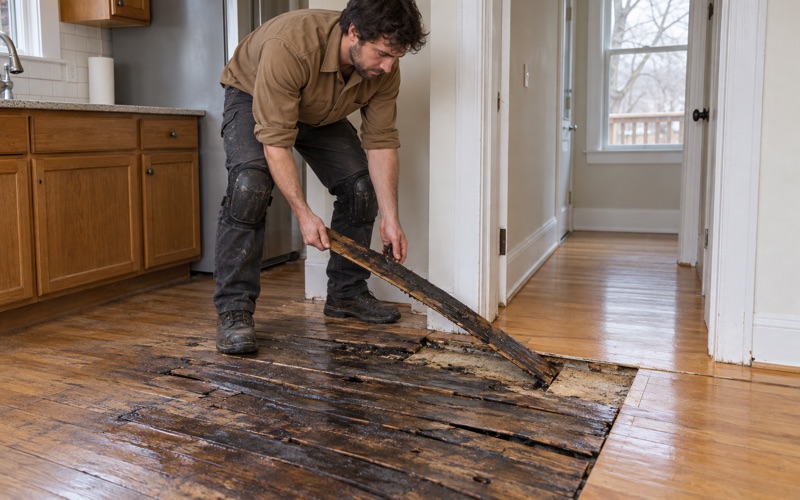
Damage patterns decide the rest. Traffic lanes worn through to bare wood, pet urine stains that have gone down into the grain, and water stains spreading from one wall are three different problems, and only the first is reliably solved by sanding. The other two get board replacement in the affected area first, then a sanding that ties the new wood to the old.
What Comes Up With the Carpet
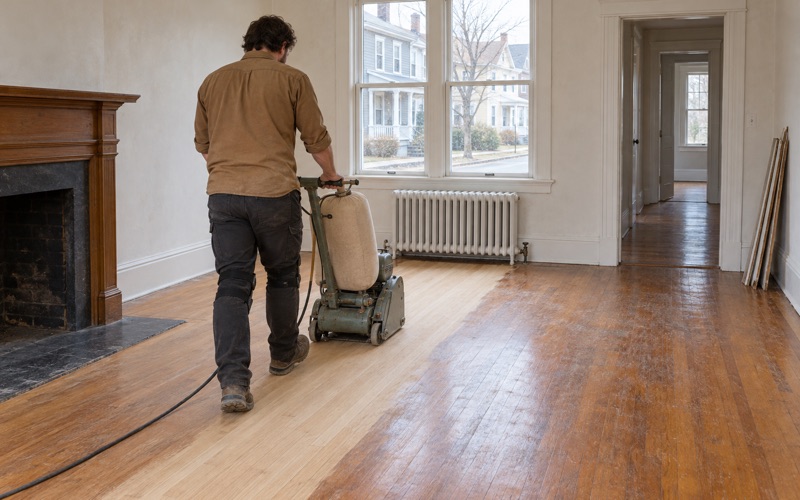
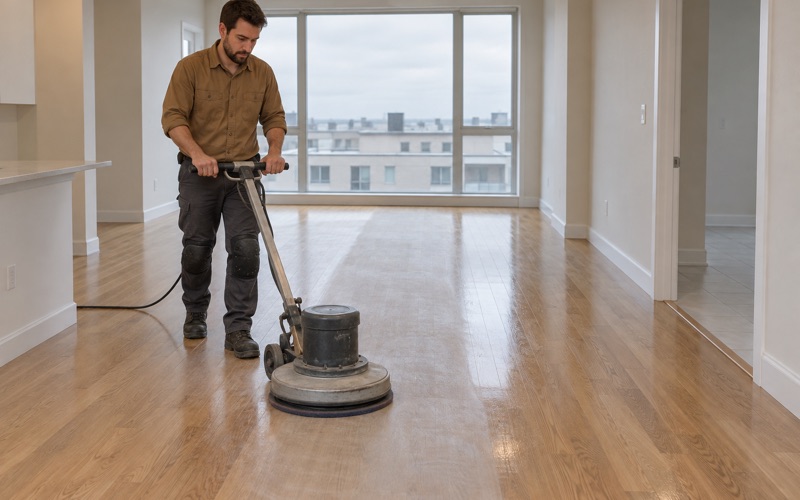
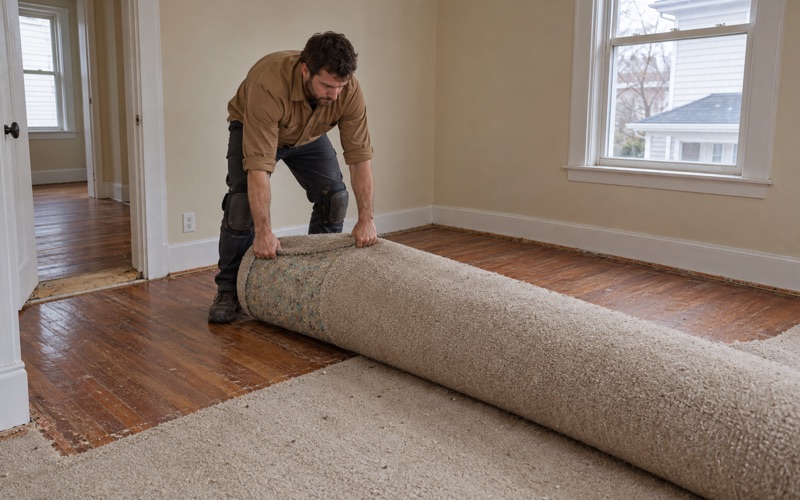
A covered floor is not a finished floor. Carpet pad, staples, tack strip, old linoleum and black mastic all come off before a drum sander or an orbital sander touches anything, because adhesive residue loads abrasive and drags contamination across the room.
Early floors add their own complication. Cut nails and face nailing sit proud of the surface in places, and each one is set or pulled before the first pass rather than discovered by the machine.
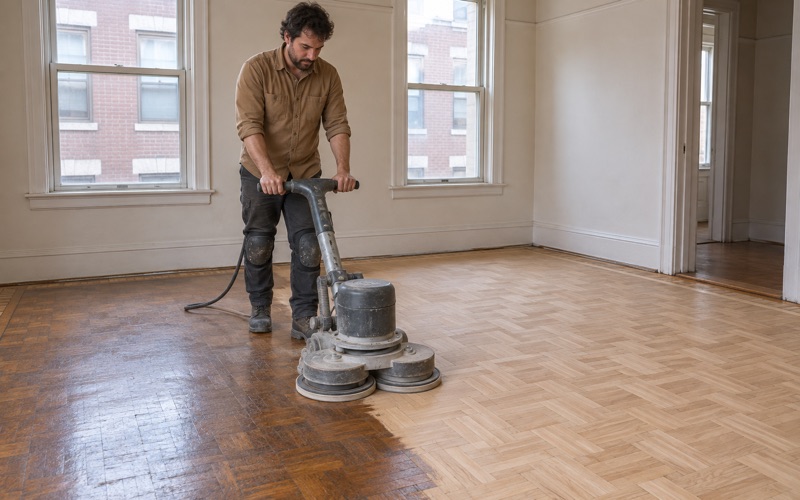
Patterned work changes the method outright. A parquet field, a herringbone run or a border of rift and quartersawn boards cannot be sanded in one direction the way a straight-laid floor can, so those rooms come down in stages with a buffer doing more of the work and the drum doing less.
Build Year, Paint and Finish Choices
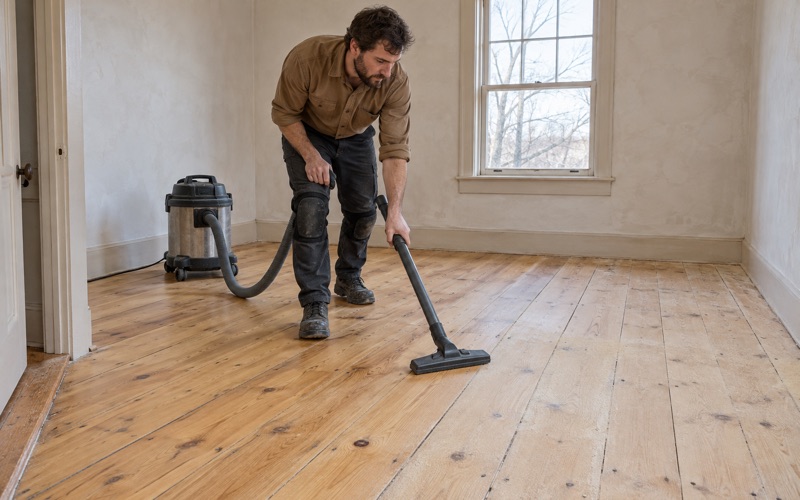
Massachusetts runs its own lead-safe renovation rules on homes built before 1978, which in a city with this much pre-1940 stock means the build year and the painted surfaces in the room are read before work is scheduled, not after. Dustless sanding with a HEPA vacuum is how we keep the dust that does get made from traveling through the house.
Finish selection is also a state question here. Massachusetts coating limits are tighter than the federal ones, so we pick from waterborne polyurethane, oil-modified polyurethane and hardwax oil against those limits, then set sheen level and stain samples on the actual boards, since orange oak under an old shellac finish never looks the way a showroom panel does.
Planning a Floor Job in Amesbury
Amesbury sits in National Weather Service forecast zone MAZ006, Western Essex, and the heating season is what most affects our schedule. Boards give up moisture through the winter and take it back in the humid months, so we run a moisture meter on the floor and the subfloor, allow acclimation for new material, and read winter gaps as a seasonal condition rather than a defect that needs filling.
Water arriving all at once is a different job. Storm water, surge and burst pipes are traced back to where they came in, dried and metered before a single board is pulled, and the room is photographed and measured for the adjuster while the floor is still wet, because that record cannot be recreated after the drying equipment leaves.
Keeping the House Livable While Work Runs
About two thirds of occupied homes here are owner-occupied and just under a third are rented, and the stock includes 648 units in two-unit buildings. In a two-family we work one floor at a time, so whoever lives on the other floor stays in the house for the duration instead of moving out for a week.
Vacant rentals run on the opposite clock. When a unit is between tenants we turn the floor around inside the window before the unit is signed off and re-let, which usually means sequencing sanding, coats and cure time against the leasing date from the first phone call.
Repairs That Match the Rest of the Floor
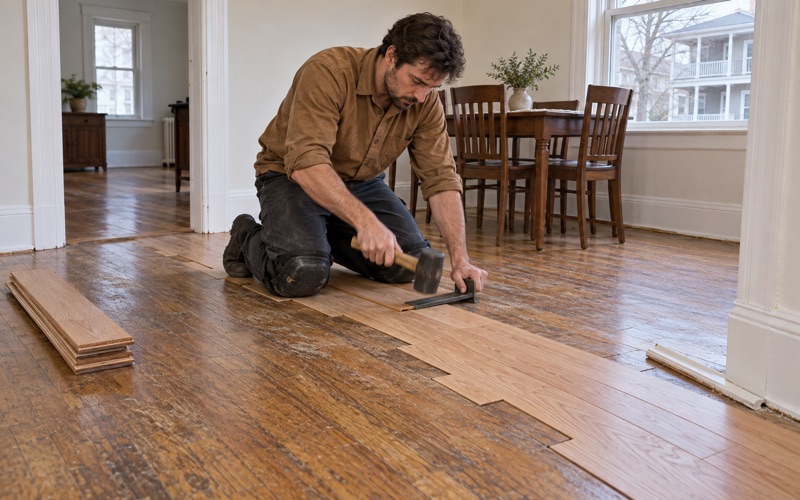
Older Amesbury houses carry scars from hardware that has since come out. Where a steam radiator or a riser was removed, we weave in matching boards on the diagonal rather than dropping in filler, so the patch disappears into the run instead of announcing itself under finish.
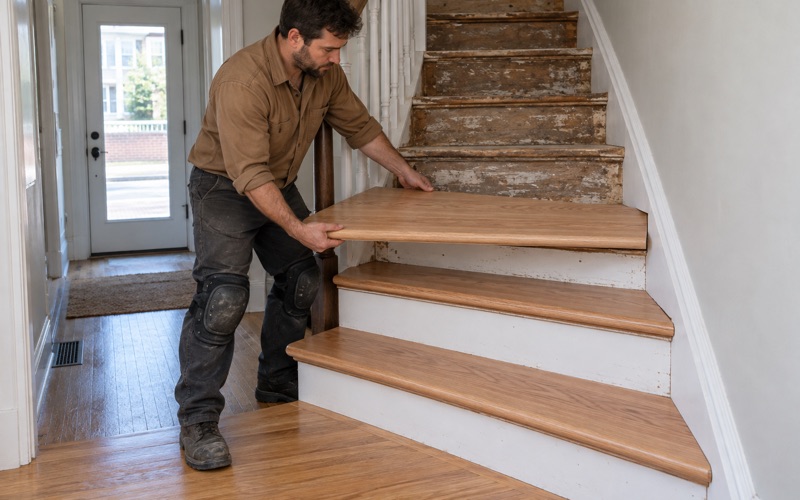
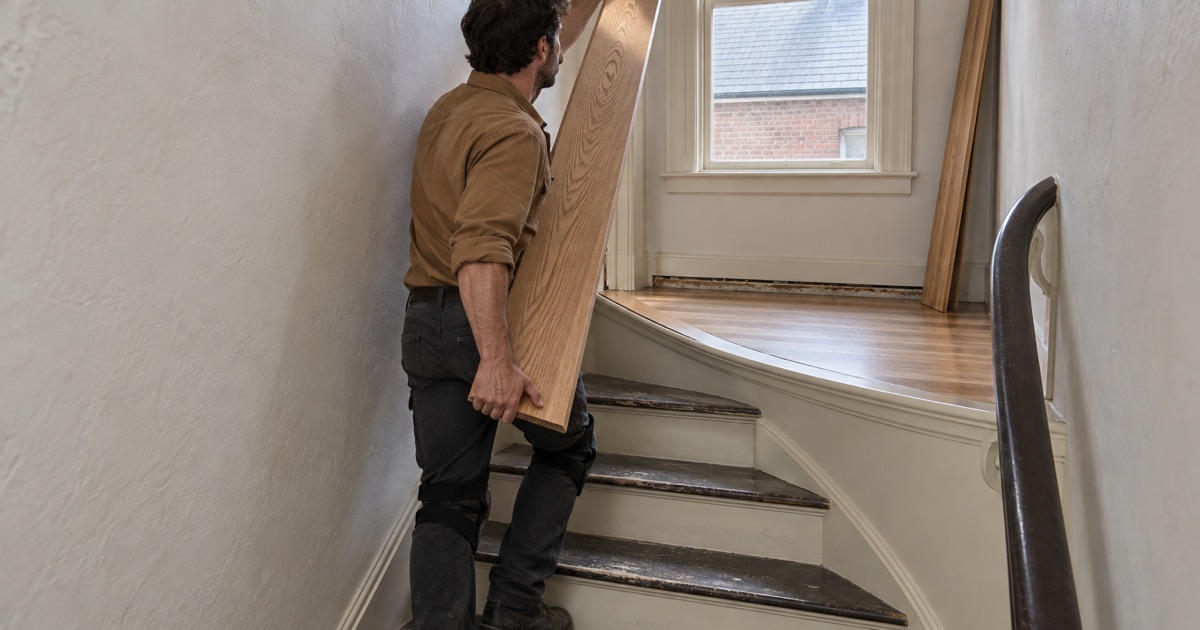
Stairs, thresholds and transitions get the same treatment and their own line on the estimate. Stair treads, risers and nosing are quoted individually, and reducers, thresholds and quarter round are matched to the finished floor so the job reads as one surface rather than a repair sitting next to an old one.
- 20+ Years on New England Floors
- Free Written Estimates
- Dustless Sanding